

Positive Aspects of Valid Dumps Ind-Dev-201 Exam Dumps! [Mar-2026]
First Attempt Guaranteed Success in Ind-Dev-201 Exam 2026
NEW QUESTION # 21
What must a developer set to allow a user to modify an attribute in the Cart's configuration window?
- A. Not Hidden property
- B. Filterable property
- C. Run-time Configurable property
- D. Active property
Answer: C
Explanation:
To allow a user to modify an attribute in the Cart's configuration window in Salesforce Industries CPQ, a developer must set the "Run-time Configurable property" for that attribute. This property enables the attribute to be edited during the configuration process within the cart, providing flexibility to the end-user to customize product specifications or choices directly from the cart interface. This is crucial for scenarios where product configurations need final adjustments before completing the order.
NEW QUESTION # 22
You want to show a starting price for a bundle with optional child products. What do you need to change?
- A. The base price of the parent product
- B. The price of all child products
- C. The pricing element
- D. The display text to show the starting price
Answer: D
Explanation:
* D. The display text to show the starting price: When you want to show a starting price for a bundle that includes optional child products, the most straightforward adjustment you can make is to the display text associated with the bundle's pricing. This allows you to communicate to customers that the price shown is the base or starting price, which may increase depending on the selected options or configurations of child products.
NEW QUESTION # 23
Which component uses a child catalog code to call the APIs and get a response with the appropriate products?
- A. dcCatalog
- B. dcChiidCatalog
- C. dcOffeisList
Answer: A
Explanation:
The component that uses a child catalog code to call APIs and retrieve a response with the appropriate products in Salesforce Industries CPQ is the dcCatalog. This component is specifically designed to interact with product catalogs, using child catalog codes to fetch relevant product information. This enables dynamic and targeted product offerings based on predefined criteria, enhancing the flexibility and responsiveness of the product selection process in guided selling scenarios.
NEW QUESTION # 24
What is a facet in Vlocity Product Console?
Note: This question displayed answer options in random order when taking this Test.
- A. An entity that is used to map context dimensions to fields in Salesforce
- B. An entity comprised of sections and section elements that appears on the left-hand navigation menu in Vlocity Product Console
- C. An entity that organizes the objects on the Product Console's Dashboard
- D. A container for a Visualforce page
Answer: B
Explanation:
In the Vlocity Product Console, a facet refers to a navigational element that organizes different sections and section elements, appearing on the left-hand side of the console. This organizational structure facilitates ease of access and management of various configuration aspects of products within the console. The facet essentially acts as a guide for users to easily navigate through different functionalities available in the Product Console.
NEW QUESTION # 25
What determines the explanation for the discounted price of a child product in a promotion?
Note: This question displayed answer options in random order when taking this Test.
- A. The promotion description
- B. The display text associated with the price adjustment or override
- C. The promotion code
- D. The display text associated with the time policy
- E. The display text associated with the base price
Answer: B
Explanation:
The explanation for the discounted price of a child product within a promotion is determined by the display text associated with the price adjustment or override. This text typically provides details about why the price has been adjusted or overridden, such as a specific promotion or discount offer. This feature is crucial for transparency, helping customers understand the pricing changes and the value offered through the promotion.
NEW QUESTION # 26
What does Vlocity Rule Builder allow you to create?
Note: This question displayed answer options in random order when taking this Test.
- A. Advanced rules using entity filters and rule actions
- B. Context rules in Vlocity Product Console
- C. Entity filters and rule actions
- D. Penalty rules for contracts and promotions
Answer: A
Explanation:
Vlocity Rule Builder, a tool within Salesforce Industries CPQ, facilitates the creation of various types of business rules that can be applied throughout the CPQ process. Here's what it allows you to create:
* A. Advanced rules using entity filters and rule actions - The Vlocity Rule Builder is specifically designed to create complex rules that include entity filters and define rule actions based on those filters.
This functionality is integral to tailoring CPQ processes to specific business needs, ensuring that only valid and necessary data drives the CPQ logic.
NEW QUESTION # 27
What can you use to build a promotion? (Choose THREE)
Note: This question displayed answer options in random order when taking this Test.
- A. A bundle within a bundle
- B. An order
- C. An asset
- D. An individual product
- E. A bundle of products
Answer: A,D,E
Explanation:
In Vlocity, you can build a promotion using:
* A. An individual product: A single product can be the basis of a promotion, offering special pricing or conditions that distinguish it from the standard offering.
* B. A bundle of products: A group of products can be combined into a bundle, which itself can be offered as a promotion. This is common in scenarios where complementary products are sold together at a discounted rate.
* C. A bundle within a bundle: Nested bundles, or a hierarchy of product bundles, can also be used to create complex promotions that provide layered pricing structures or purchasing incentives.
These options provide flexibility in designing promotions that cater to diverse market needs and customer preferences, enhancing the effectiveness of sales strategies in competitive markets.
NEW QUESTION # 28
What designates an attributeas a product attribute?
Note: This question displayed answer options in random order when taking this Test.
- A. Assigning the attribute to a product or an object type
- B. Setting the type to Product Attribute
- C. Creating the attribute through Vlocity Product Console
- D. Setting its applicable object to Product2
Answer: A
Explanation:
An attribute is designated as a product attribute within Salesforce Industries CPQ by assigning it to a product or an object type. This assignment directly links the attribute to a specific product or category, defining its role and function within the product configuration. This is crucial for ensuring that attributes are applicable and visible in contexts where they are relevant, enhancing the configurability and specificity of product offerings within the CPQ system.
NEW QUESTION # 29
Vlocity Picklists can be assigned to attributes at which of the followinglevels?
Note: This question displayed answer options in random order when taking this Test.
- A. Attributes and Products
- B. Attributes, Object Types, and Products
- C. Attributes and Object Types
- D. Attributes, Attribute Categories and Products
Answer: B
Explanation:
Vlocity picklists can be assigned to attributes at the levels of Attributes, Object Types, and Products. This level of assignment flexibility ensures that picklists can be used effectively across various dimensions of the product configuration and sales processes, facilitating better data management and consistency across the platform.
* Attributes, Object Types, and Products: This broad applicability allows for comprehensive and cohesive data management strategies, aligning picklist values across multiple levels of product and service definitions.
NEW QUESTION # 30
What is the purpose of the Collapse Hierarchy flag when defining a product bundle?
Note: This question displayed answer options in random order when taking this Test.
- A. Collapses the product hierarchy data key value pairs, in order to improve performance for very large bundles
- B. Enables a Search Item dialog for the product bundle in the cart line items pane
- C. Restricts the product from retrieving cardinality settings from any linked object types
- D. Allows the product to inherit the parent product's cardinality
Answer: A
Explanation:
The Collapse Hierarchy flag when defining a product bundle in Salesforce Industries CPQ is used to:
* Collapse the product hierarchy data key value pairs, in order to improve performance for very large bundles: This flag simplifies the product hierarchy representation by collapsing it into fewer levels. This is particularly useful in enhancing performance by reducing the complexity and depth of product hierarchies during the configuration and pricing processes, especially in large, nested bundles.
By collapsing the hierarchy, the system can process large bundles more efficiently, leading to quicker load times and less strain on the system during complex configuration scenarios.
NEW QUESTION # 31
Which Lightning web component allows the user to submit their payment details?
- A. dcCneckouiPaymem
- B. dcOfferConfig
- C. dcUpdateBHIingAddress
- D. dcReviewOrder
Answer: A
Explanation:
The Lightning web component in Salesforce Industries CPQ that allows the user to submit their payment details is dcCheckoutPayment. This component is specifically designed to handle payment processing within the CPQ system, providing a secure and user-friendly interface for customers to enter and submit their payment information as part of the checkout process. It ensures the secure handling of sensitive financial data and integrates seamlessly with payment gateways and financial systems.
NEW QUESTION # 32
Each time a new smartphone is offered, the company wants to automatically decrease its price over time. How could this be done?
Note: This question displayed answer options in random order when taking this Test.
- A. Using a rule and time plans to control effectivity
- B. Using a rule and time policies to control effectivity
- C. Using price list entries with effectivity time frames
- D. Usingmultiple price lists with effectivity time frames
Answer: C
Explanation:
To automatically decrease the price of a new smartphone over time within Salesforce Industries CPQ: D.
Using price list entries with effectivity time frames: This method allows for setting different prices for the same product that automatically become effective at predefined times. By creating multiple price list entries for the smartphone each with different prices and specific start dates, the system can automatically update the price based on the current date.
This approach simplifies managing price reductions over a product's lifecycle, making it efficient to implement and transparent to users.
References:
* Salesforce Industries CPQ Implementation Guide.
* Examples of using effectivity time frames in Salesforce Industries CPQ price management.
NEW QUESTION # 33
In Vlocity CME. if you want to regenerate the JSON attribute fields forall products in your product catalog, what job should you run?
Note: This question displayed answer options in random order when taking this Test.
- A. ResolveProductHierarchyBatchJob, which can be run via the Product Hierarchy Maintenance function on the CMT Administration screen.
- B. ProductAttributesBatchProcessor, which can be run via the Refresh Pricebook function on the CMT Administration screen.
- C. ProductHierarchyBatchProcessor, which can be run via the Refresh Pricebook function on the CMT Administration screen.
- D. EPCProductAttribJSONBatchJob. accessible in Vlocity University's training orgs via the Process Attributesbutton.
Answer: D
Explanation:
In the context of Vlocity CME, to regenerate the JSON attribute fields for all products in your product catalog, the job to run is:
* A. EPCProductAttribJSONBatchJob: This job is specifically designed to handle the regeneration of JSON attribute fields within the product catalog. It can typically be accessed in training environments such as those provided by Vlocity University through the "Process Attributes" button. This job processes the attributes and ensures they are up-to-date and correctly formatted, which is vital for maintaining the functional integrity of product configurations.
NEW QUESTION # 34
Picklist entities in Vlocity EPC are globally reusable Salesforce picklists, and can be administered either through Vlocity Product Console or Setup.
- A. False
- B. True
Answer: B
Explanation:
Picklist entities in Vlocity EPC (Enterprise Product Catalog), which is part of Salesforce Industries CPQ, are indeed globally reusable Salesforce picklists. These picklists can be managed through the Vlocity Product Console or the Salesforce Setup. This feature allows for centralized management of picklist values which can be used across various Salesforce and Vlocity applications, enhancing consistency and maintainability of data.
NEW QUESTION # 35
In Vlocity Context Rules, what is the purpose of a rule set?
- A. To define the cardinality used during rule processing
- B. To combine Advanced Rules and Context Rules into a set
- C. To contain one or more context rules in a set that can be assigned to products, promotions or price list entries
- D. To organize context rules in logical group during design-time
Answer: C
Explanation:
In Vlocity's context rules, the purpose of a rule set is:
* A. To contain one or more context rules in a set that can be assigned to products, promotions, or price list entries: A rule set groups multiple context rules that can be applied to different elements within Salesforce Industries CPQ. This grouping enables complex logic to be managed and reused effectively.
NEW QUESTION # 36
Which of the following are contained in the shared catalog? (Select THREE)
- A. Technical Products
- B. Commercial Products
- C. Decomposition States
- D. Orchestration Plans
- E. Decomposition Relationships
Answer: A,B,D
Explanation:
* C. Commercial Products: Commercial products represent the marketable items available to customers, which are typically included in a shared catalog.
* D. Technical Products: These are items that support the commercial products, often not visible to the customer but crucial for service delivery and product configuration.
* E. Orchestration Plans: Orchestration plans, which define the steps and processes to fulfill and manage orders, are also typically part of the shared catalog in Salesforce Industries CPQ.
NEW QUESTION # 37
In Vlocity Context Rules, what type of component can be linked to a Vlocity picklist?
Note: This question displayed answer options in random order when taking this Test.
- A. Context Rule Set
- B. Context Scope
- C. Context Mapping
- D. Context Dimension
Answer: D
Explanation:
In Salesforce Industries CPQ using Vlocity, a picklist can be linked to a Context Dimension. Context Dimensions in Vlocity CPQ represent a way to define and handle data dynamically within the CPQ process.
By linking a picklist to a Context Dimension, users can effectively manage options that are dependent on certain contexts within the sales or quoting processes, making it versatile for adapting to various business scenarios.
NEW QUESTION # 38
Carole White currently has Internet service at her primary residence but she will be relocating to a new address. What action can be taken to best assist her in the relocation process?
Note: This question displayed answer options in random order when taking this Test.
- A. "Change to Order" action on the selected Asset
- B. "Change to Quote" action on the selected Asset
- C. "Move" action on the selected Asset
- D. "Move action" on the original Order
Answer: C
Explanation:
For Carole White who is relocating to a new address, the best action to assist in the relocation process in terms of managing her services would be:
* "Move" action on the selected Asset (A): This action is specifically designed to handle the transfer of services from one location to another, updating the service address and related billing and service details accordingly.
NEW QUESTION # 39
What does a sales catalog define?
- A. A set of products and promotions
- B. A catalog of technical and commercial products
- C. A set of products that are related through Relies On dependences
- D. A catalog of prices
Answer: A
Explanation:
A sales catalog in Salesforce Industries CPQ defines a set of products and promotions. It organizes and categorizes products in a way that is easily accessible and manageable, allowing businesses to bundle products and apply promotions efficiently. This catalog setup helps in streamlining the sales process and enabling sales representatives to quickly find products and associated promotions.
NEW QUESTION # 40
To ignore the base price of a child product in apromotion and change it to a different price, what would you use?
Note: This question displayed answer options in random order when taking this Test.
- A. A rule
- B. An override
- C. An adjustment
- D. A price list entry
Answer: B
Explanation:
To change the base price of a child product in a promotion to a different price, you would use an "override".
Overrides allow you to set a specific price for a product within a promotion, disregarding its listed base price.
This functionality is essential for promotions where special pricing is a key aspect of the sales strategy, providing flexibility to offer promotional pricing that may differ significantly from the standard pricing.
NEW QUESTION # 41
In Vlocity Cart, how are the prices in the selectable Product List calculated?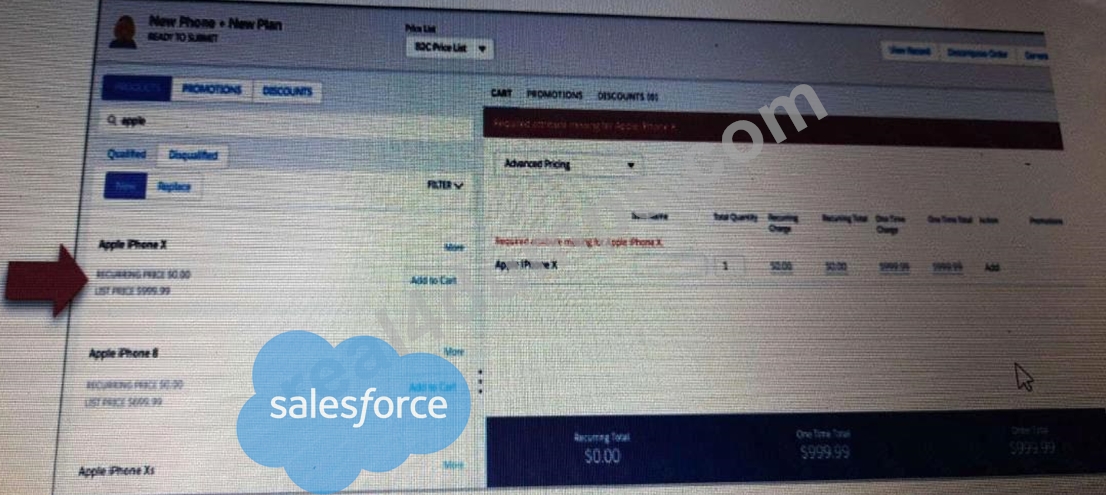
- A. All of the above
- B. Using Advanced Rules pricing rules
- C. Using list pricing as defined on the price list with no calculation
- D. Using Context Rules associated with the price list
Answer: A
Explanation:
In Vlocity Cart, the prices in the selectable Product List are calculated using multiple methods:
* Using list pricing as defined on the price list with no calculation (A): This involves straightforward application of the pre-defined list prices associated with each product.
* Using Advanced Rules pricing rules (B): Advanced rules can modify pricing based on specific conditions and criteria, such as customer segment, quantity, or promotional offers.
* Using Context Rules associated with the price list (C): Context rules can adjust prices based on the broader context of the transaction, like customer location or market conditions. Thus, all of these methods can be involved in the price calculation process, making (D) All of the above the correct answer.
NEW QUESTION # 42
A product manager wants to create a product bundle that can only be ordered between January 5thand January
31st.
How should the developer configure the product bundle to meet this requirement?
- A. Set the Fulfillment Start Date to January 5 and the End of Life Date to January 31
- B. Set the Selling StartDate to January 5 and the Selling End Date to January 31
- C. Enable the Active property on January 5 and disable the Active property on January 31
- D. Set the Fulfillment Start Date to January 4, Selling Start Date to January 5, and the End at life Date February 1
Answer: B
Explanation:
To limit the ordering of a product bundle to the specific dates between January 5th and January 31st, the following configuration is most appropriate: C. Set the Selling Start Date to January 5 and the Selling End Date to January 31: This configuration directly restricts the availability of the product for purchase to between these specific dates, aligning precisely with the product manager's requirements.
NEW QUESTION # 43
In Vlocity Cart, which of the following rules are run in the cartline items panel to determine required or excluded products and/or compatibility?
Note: This question displayed answer options in random order when taking this Test.
- A. Evaluation Context Rules
- B. Configuration Validation (Compatibility) Context Rules
- C. Qualification Context Rules
- D. Configuration Validation (Compatibility) Advanced Rules
Answer: B
Explanation:
In the Vlocity Cart within Salesforce Industries CPQ, the rules that are run in the cartline items panel to determine required or excluded products and/or compatibility are:
* Configuration Validation (Compatibility) Context Rules (D) - These rules are specifically designed to assess compatibility between products in the cartline. They are executed to ensure that the products added to the cart are compatible with each other based on predefined criteria.
NEW QUESTION # 44
Rules always execute if they are active.
- A. False
- B. True
Answer: A
Explanation:
It is false that rules always execute if they are active. In Vlocity CPQ, active rules only execute under conditions for which they are specifically designed. This means that even if a rule is active, it requires certain triggers or conditions to be met for execution. This design prevents unnecessary rule processing and ensures that system resources are used efficiently by only applying rules when they are contextually relevant. This conditional execution is crucial for maintaining performance and accuracy in complex configurations like those in large product catalogs.
NEW QUESTION # 45
......
Practice LATEST Ind-Dev-201 Exam Updated 320 Questions: https://prep4sure.real4dumps.com/Ind-Dev-201-prep4sure-exam.html
