

CBDA Exam Brain Dumps - Study Notes and Theory [May-2024]
100% Guaranteed Results CBDA Unlimited 152 Questions
NEW QUESTION # 37
After analyzing sales data, the analytics team finds that the older the customer, the more expensive the neckties purchased. The team felt this was a breakthrough insight but on closer analysis realized that other factors could account for this relationship. This is a clear indication that:
- A. Correlation between variables implies causation
- B. Causation between variables does not imply correlation
- C. Correlation between variables does not imply causation
- D. Causation has no relationship with correlation
Answer: C
Explanation:
The analytics team found a correlation between the age of the customer and the price of the neckties purchased, meaning that as one variable changes, the other tends to change in the same direction. However, this correlation does not imply causation, meaning that one variable does not necessarily cause the other to change. There could be other factors, such as income, preference, or quality, that affect both variables and create a spurious relationship. Therefore, the team realized that they need to investigate further to determine if there is a causal link between the variables, or if the correlation is coincidental12 References: 1: Correlation vs. Causation | Difference, Designs & Examples - Scribbr 2: Correlation vs Causation: Understanding the Differences - Statistics By Jim
NEW QUESTION # 38
What is the relationship between a Customer entity and an Order entity, where a customer entry will be present in the Customer entity only if they have made an order?
- A. one-to-one
- B. one-to-many
- C. zero-to-one
- D. many-to-many
Answer: C
Explanation:
The relationship between a Customer entity and an Order entity, where a customer entry will be present in the Customer entity only if they have made an order, is a zero-to-one relationship. This means that for each record in the Order entity, there can be either zero or one record in the Customer entity that is related to it. This implies that the Order entity is optional for the Customer entity, and the Customer entity is mandatory for the Order entity12 References: 1: A Guide to the Entity Relationship Diagram (ERD) - Database Star 2:
Developing an Application - Oracle
NEW QUESTION # 39
A research marketer is interested in collecting information about the spending habits of families in North America. Concerned about the volume of data required to conduct the research, they choose to use sampling.
The dataset is sourced using all credit card transactions from a leading North American credit card company for Quarter 1 of the prior year. The sample used is:
- A. Biased
- B. Statistically representative
- C. Not relevant
- D. Too large to be helpful
Answer: A
Explanation:
The sample used in this case is biased, meaning that it is not representative of the population of interest. The population of interest is the families in North America, but the sample is drawn from only one source of data:
the credit card transactions from a leading North American credit card company. This sample excludes the families who do not use credit cards, or who use other credit card companies, or who use other payment methods. Therefore, the sample is not random or fair, and it may introduce sampling bias into the research results12 References: 1: Sampling Methods | Types, Techniques & Examples 2: Sampling Bias - an overview | ScienceDirect Topics
NEW QUESTION # 40
While creating a dataset for analysis, the analyst reviews the data collected and finds a large percentage of records are missing values. Which activity would the analyst perform in order to use this dataset?
- A. Scale validation
- B. Weighting
- C. Factor analysis
- D. Clustering
Answer: B
Explanation:
Weighting is a technique that assigns different values or weights to different records or variables in a dataset, based on their importance or relevance. Weighting can be used to handle missing values by giving them a lower weight or imputing them with a weighted average of other values. Weighting can also help to adjust for sampling bias or non-response bias in the data collection process. References:
*Understanding the Guide to Business Data Analytics, page 16
*Business Analysis Certification in Data Analytics, CBDA | IIBA®, CBDA Competencies, Domain 3:
Analyze Data
*CERTIFICATION IN BUSINESS DATA ANALYTICS HANDBOOK - IIBA®, page 8, CBDA Exam Sample Questions and Self-Assessment, Question 4
NEW QUESTION # 41
The analytics team has been asked to assess sales data from their company's website with the hopes of providing insights to help increase online sales. It's the first time the team is looking at this specific data and they are concerned about the quality of data that has been captured. They decide to use the following approach as the next step:
- A. Exploratory analysis
- B. Trend Analysis
- C. Data Analysis
- D. Classification analysis
Answer: A
Explanation:
Exploratory analysis is the approach that the analytics team should use as the next step, because it is a technique that allows them to examine the quality, structure, and characteristics of the data, without making any assumptions or hypotheses. Exploratory analysis can help the team identify any issues or anomalies in the data, such as missing values, outliers, or errors, and decide how to handle them. Exploratory analysis can also help the team discover any patterns, trends, or relationships in the data, and generate new research questions or hypotheses for further analysis. References:
*Business Analysis Certification in Data Analytics, CBDA | IIBA®, CBDA Competencies, Domain 3:
Analyze Data
*Understanding the Guide to Business Data Analytics, page 16
*CERTIFICATION IN BUSINESS DATA ANALYTICS HANDBOOK - IIBA®, page 8, CBDA Exam Sample Questions and Self-Assessment, Question 8
NEW QUESTION # 42
DIAGRAM
The following boxplot is produced from a dataset. From this boxplot which of the following conclusions can be drawn?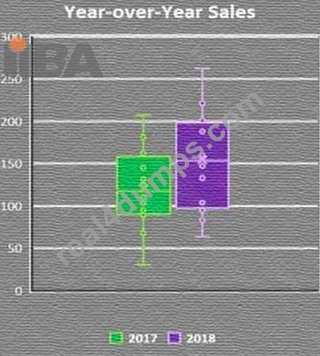
Year-over-Year Sales
300
200
- A. The medians and the inter-quartile range is the same in each group
- B. The medians are the same but the inter-quartile ranges are not
- C. The medians and the inter-quartile ranges are different in each group
- D. The inter-quartile ranges are the same but the medians are not
Answer: C
Explanation:
According to the Guide to Business Data Analytics, a boxplot is used to provide a visual summary of one or more groups of data values through their quartiles. In this case, the boxplot shows two different years, 2017 and 2018, with distinct medians and interquartile ranges. The median is represented by the line inside the box, while the interquartile range is represented by the height of the box itself. Outliers are marked with circles above and below the box. From the boxplot, we can see that the median sales for 2018 are higher than the median sales for 2017, and the interquartile range for 2018 is narrower than the interquartile range for 2017.
This means that the sales for 2018 are more concentrated around the median and have less variability than the sales for 2017. Therefore, the correct answer is B.
References: Guide to Business Data Analytics, page 58-59; CBDA Exam Blueprint, page 7; [Introduction to Business Data Analytics: A Practitioner View], page 17.
![Year-over-Year Sales]
NEW QUESTION # 43
The research question prompting the use of analytics is well-defined. The team obtains the results and determines that the source data did not provide reliable results. As a result of this finding, the team modifies the original question to one that can be answered by the data. What is a risk that could impact the value of this analysis?
- A. Increased costs associated with the source data
- B. The quality of the analysis may be negatively impacted
- C. Timelines will be pushed out making stakeholders unhappy
- D. The objective of the original research may not be met
Answer: D
Explanation:
The risk that could impact the value of this analysis is that the objective of the original research may not be met, because the team modified the research question to fit the data, rather than finding the data that fits the research question. This could lead to a loss of alignment between the research question and the business problem, stakeholder needs, or analytical methods. The team may end up answering a different or less relevant question than the one they intended to answer, and thus provide less valuable insights or recommendations.
References:
*Business Analysis Certification in Data Analytics, CBDA | IIBA®, CBDA Competencies, Domain 1: Identify the Research Questions
*Understanding the Guide to Business Data Analytics, page 10-11
*CERTIFICATION IN BUSINESS DATA ANALYTICS HANDBOOK - IIBA®, page 8, CBDA Exam Sample Questions and Self-Assessment, Question 10
NEW QUESTION # 44
Interested in experimenting with analytics, a manufacturing company hires an analyst to see how the capability can be developed within its organization. The analyst is getting started and recognizes the need to show value from the onset of their work to gain upper management's trust and future funding. What action will accomplish these objectives?
- A. Perform a market analysis to understand how competitors are using analytics and then launch a similar initiative
- B. Develop a meaningful question that can be answered with data the company already has in its possession
- C. Solve the biggest problem the organization has first to quickly grab the support and attention of senior management
- D. Develop a question that can be answered quickly regardless of alignment to strategy, just to get started
Answer: B
Explanation:
Explanation
The best action for the analyst to show value from the onset of their work is to develop a meaningful question that can be answered with data the company already has in its possession. This way, the analyst can demonstrate the potential of analytics to solve relevant business problems, without spending too much time or resources on data collection or market research. The question should also be aligned with the organization's strategy and goals, and provide actionable insights for decision making12. References: 1: Guide to Business Data Analytics, IIBA, 2020, p. 202: Data Science for Business, Foster Provost and Tom Fawcett, 2013, p. 14.
NEW QUESTION # 45
Freedom Insurance is planning to offer a new type of insurance policy and would like to determine how to optimally price it. The company seeks to identify the characteristics of this policy that would produce the maximum profit in the coming year. What type of analytics would Freedom Insurance be considering to achieve this objective?
- A. Prescriptive analytics
- B. Descriptive analytics
- C. Retrospective analytics
- D. Predictive analytics
Answer: A
Explanation:
According to the Guide to Business Data Analytics, prescriptive analytics is a type of analytics that provides recommendations or suggestions for optimal actions or decisions based on data analysis. Prescriptive analytics uses techniques such as optimization, simulation, and decision analysis to evaluate various scenarios and trade-offs and to determine the best course of action for a given objective and constraint. Prescriptive analytics can help organizations achieve their goals, improve their performance, and increase their efficiency and effectiveness. In this situation, Freedom Insurance wants to determine how to optimally price a new type of insurance policy that would produce the maximum profit in the coming year. This is a prescriptive analytics problem, as it involves finding the optimal solution for a complex and uncertain decision problem.
References: Guide to Business Data Analytics, page 49-50; CBDA Exam Blueprint, page 7; [Introduction to Business Data Analytics: A Practitioner View], page 14.
NEW QUESTION # 46
A Human Resource manager recently learned that their competitor reduced employee attrition rates by 20% after implementing personality tests as part of their screening process. Intrigued by the idea, the manager suggests collecting data on personality tests and attrition rates over the next year. The data from this year is then analyzed to explore possible relationships. What type of analytics has the team been asked to perform?
- A. Diagnostic
- B. Predictive
- C. Prescriptive
- D. Descriptive
Answer: D
Explanation:
Descriptive analytics is a type of analytics that summarizes and visualizes the data to provide an overview of what has happened or is happening, such as the attrition rates and the personality test scores of the employees12. The team has been asked to perform descriptive analytics to explore possible relationships between the data variables, without making any predictions or prescriptions for the future. References: 1:
Guide to Business Data Analytics, IIBA, 2020, p. 182: Business Analytics: Data Analysis & Decision Making,
S. Christian Albright and Wayne L. Winston, 2015, p. 5.
NEW QUESTION # 47
Collaborative games are used by a business analyst to identify the research questions to be explored within an analytics system.
Participants are asked to write down a research question on a sticky note, put the notes on the wall, and move them towards related research questions. What type of Collaborative game is being played?
- A. People polling
- B. Product Box
- C. Affinity Map
- D. Fishbowl
Answer: C
Explanation:
Explanation
An affinity map is a collaborative game that helps participants to group similar ideas or features together. It is useful for identifying research questions that are related to each other and finding common themes or patterns.
In this game, participants write down their research questions on sticky notes and place them on the wall.
Then, they move the notes around to form clusters of related questions. The clusters can be labeled with a descriptive name or a question that summarizes the theme. An affinity map can help participants to prioritize the most important or relevant research questions and generate insights from the data.
https://businessanalystmentor.com/collaborative-games-business-analysis/
NEW QUESTION # 48
The analytics team scheduled a meeting with key stakeholders to present their recommendations. The team envisioned this as the final step of their work and fully expected complete acceptance of those recommendations, particularly given that very few questions were asked. They were surprisedwhen they received word that the organization wasn't ready to move forward. What did they overlook?
- A. Communicating information requires a written report
- B. Stakeholders need to hear the same information multiple times
- C. Communicating information is bi-directional and iterative
- D. Stakeholders never make quick decisions
Answer: C
NEW QUESTION # 49
The analytics team has been asked to assess sales data from their company's website with the hopes of providing insights to help increase online sales. It's the first time the team is looking at this specific data and they are concerned about the quality of data that has been captured. They decide to use the following approach as the next step:
- A. Exploratory analysis
- B. Trend Analysis
- C. Data Analysis
- D. Classification analysis
Answer: A
Explanation:
Explanation
Exploratory analysis is the approach that the analytics team should use as the next step, because it is a technique that allows them to examine the quality, structure, and characteristics of the data, without making any assumptions or hypotheses. Exploratory analysis can help the team identify any issues or anomalies in the data, such as missing values, outliers, or errors, and decide how to handle them. Exploratory analysis can also help the team discover any patterns, trends, or relationships in the data, and generate new research questions or hypotheses for further analysis. References:
*Business Analysis Certification in Data Analytics, CBDA | IIBA®, CBDA Competencies, Domain 3:
Analyze Data
*Understanding the Guide to Business Data Analytics, page 16
*CERTIFICATION IN BUSINESS DATA ANALYTICS HANDBOOK - IIBA®, page 8, CBDA Exam Sample Questions and Self-Assessment, Question 8
NEW QUESTION # 50
A call center has requested to review their sales conversion data for the month. The analyst working on this request is trying to identify the chart that will effectively present the data, which includes: the number of leads, the number of calls made, the number of calls completed, the number of customers interested and the number of sales. What chart should the analyst use to show the values across each stage of the pipeline?
- A. Bar chart
- B. Pie chart
- C. Bullet chart
- D. Funnel chart
Answer: D
Explanation:
A funnel chart is a type of chart that shows the values of different stages of a process, such as a sales pipeline, where each stage represents a subset of the previous one. A funnel chart is useful for showing the conversion rate, the drop-off rate, and the potential revenue or profit at each stage12. A funnel chart would be an effective way to present the data requested by the call center, as it would show the number of leads, calls, customers, and sales, as well as the percentage of change between each stage. References: 1: Guide to Business Data Analytics, IIBA, 2020, p. 662: Data Visualization: A Practical Introduction, Kieran Healy, 2018, p. 233.
NEW QUESTION # 51
An analyst at a supermarket chain has been asked to extract data from multiple data sources to complete a study on customer spending habits. The analyst is going to query data from various databases. Which statement is true about database querying?
- A. A querying language is independent of the type of database being used
- B. Irrespective of the querying language used, data results retrieved are always in a tabular format
- C. Querying can be used to create predictive data models
- D. Querying is a structured way of searching, manipulating and managing data
Answer: D
Explanation:
Explanation
Querying is a technique that allows analysts to access, filter, join, aggregate, and transform data from various databases using a specific syntax and logic1. Querying can be used for different purposes, such as data exploration, data preparation, data analysis, and data visualization2. Querying is not limited to creating predictive data models, nor does it always produce tabular results. Moreover, querying languages may vary depending on the type and structure of the database, such as relational, hierarchical, or document-based3.
References: 1: Guide to Business Data Analytics, IIBA, 2020, p. 552: Data Analysis Using SQL and Excel, Gordon S. Linoff, 2016, p. 33: Database Systems: Design, Implementation, and Management, Carlos Coronel and Steven Morris, 2019, p. 17.
NEW QUESTION # 52
An online retailer of men's athletic apparel is seeking to become the market leader in the industry. To deliver on this strategy, the analytics team continuously collects data on the prices of competitor products and uses this information to adjust the retailer's prices. What type of analytics is the retailer using to maintain their pricing structure?
- A. Diagnostic
- B. Predictive
- C. Prescriptive
- D. Descriptive
Answer: C
Explanation:
Explanation
Prescriptive analytics is the type of analytics that the retailer is using to maintain their pricing structure, because it is a technique that uses data and models to recommend the best course of action for a given situation. Prescriptive analytics can help the retailer optimize their prices based on the data collected from the competitors, the market conditions, and the customer preferences, and thus achieve their strategic goal of becoming the market leader. References:
*Business Analysis Certification in Data Analytics, CBDA | IIBA®, CBDA Competencies, Domain 3:
Analyze Data
*Understanding the Guide to Business Data Analytics, page 17
*CERTIFICATION IN BUSINESS DATA ANALYTICS HANDBOOK - IIBA®, page 8, CBDA Exam Sample Questions and Self-Assessment, Question 11
NEW QUESTION # 53
An HR manager attended a conference where the topic of HR analytics was presented. The manager returned to the office feeling strongly that analytics could be used to guide hiring decisions in the future. Which of the following results would assist the HR team in making such decisions?
- A. Employee skill gaps
- B. Employee engagement scores
- C. Workforce performance
- D. Absentee rates
Answer: A
Explanation:
According to the Introduction to Business Data Analytics: A Practitioner View, employee skill gaps are the differences between the skills that employees have and the skills that they need to perform their jobs effectively. Employee skill gaps can affect the productivity, quality, and innovation of an organization. HR analytics can help identify and measure employee skill gaps and provide insights on how to close them. HR analytics can also help guide hiring decisions by finding the best candidates who have the required skills or the potential to acquire them. By using HR analytics to address employee skill gaps, the HR team can improve the alignment of human capital with organizational goals and strategies.
References: Introduction to Business Data Analytics: A Practitioner View, page 17; CBDA Exam Blueprint, page 7; What is HR Analytics? All You Need to Know to Get Started
NEW QUESTION # 54
The analytics team has completed their analytics work and have agreed on a set of five key recommendations.
They are now discussing how best to communicate these recommendations to the finance, customer service, and marketing teams. Recognizing that this is a diverse set of stakeholders, the business analysis professional reminds the team:
- A. All stakeholders should receive information about the recommendation in the same way
- B. Stakeholders only have the ability to understand summarized recommendations
- C. Recommendations are important and must be communicated with as much detail as possible
- D. The recommendation should be communicated in different ways for different stakeholders
Answer: D
Explanation:
According to the Guide to Business Data Analytics, the recommendation is the output of the data analysis that provides suggestions or guidance for actions or decisions based on the data insights. The recommendation should be communicated in different ways for different stakeholders, depending on their needs, preferences, and expectations. The communication should consider the following factors:
* The level of detail and complexity: Some stakeholders may require more or less detail and complexity in
* the recommendation, depending on their role, responsibility, and involvement in the data analysis project. For example, the finance team may need more detail and complexity than the customer service team, as they are more concerned with the financial implications and feasibility of the recommendation.
* The format and medium: Some stakeholders may prefer different formats and mediums for receiving the recommendation, depending on their availability, accessibility, and learning style. For example, the marketing team may prefer a visual and interactive format, such as a dashboard or a presentation, than a textual and static format, such as a report or a document.
* The tone and language: Some stakeholders may respond better to different tones and languages for the recommendation, depending on their culture, background, and personality. For example, some stakeholders may appreciate a formal and professional tone and language, while others may prefer a casual and friendly tone and language.
The communication should also follow the principles of clarity, accuracy, relevance, and timeliness, as well as adhere to the ethical and legal standards for data privacy and security.
References: Guide to Business Data Analytics, page 50-51; CBDA Exam Blueprint, page 7; [Introduction toBusiness Data Analytics: A Practitioner View], page 16.
NEW QUESTION # 55
A financial institution is interested in leveraging analytics to address a recent surge in credit card fraud. The company has decided to invest in streaming analytics to obtain instant access to real-time data to stop fraudulent behavior before it occurs. Which practice will help the financial institution integrate the data as it is collected?
- A. Data quality
- B. Data architecture
- C. Data security
- D. Data management
Answer: B
Explanation:
Data architecture is the practice of designing and implementing the structures, models, standards, and processes that enable data integration, storage, and consumption. Data architecture is essential for streaming analytics, as it defines how data is collected, processed, and delivered in real time from multiple sources. Data architecture helps the financial institution integrate the data as it is collected by ensuring data compatibility, consistency, and quality across the streaming pipeline. Data architecture also supports data security, scalability, and performance for streaming analytics. References:
* Certification in Business Data Analytics (IIBA ® - CBDA), IIBA, accessed on January 20, 2024.
* Business Data Analytics Certification - CBDA Competencies | IIBA®, IIBA, accessed on January 20,
2024.
* Guide to Business Data Analytics, IIBA, 2020, p. 17-18.
* What is Streaming Analytics? | Google Cloud, Google Cloud, accessed on January 20, 2024.
* What is Data Integration? | IBM, IBM, accessed on January 20, 2024.
NEW QUESTION # 56
A real estate broker is tracking monthly sales between two of its teams. The results have been visualized. What insights can be drawn from the chart?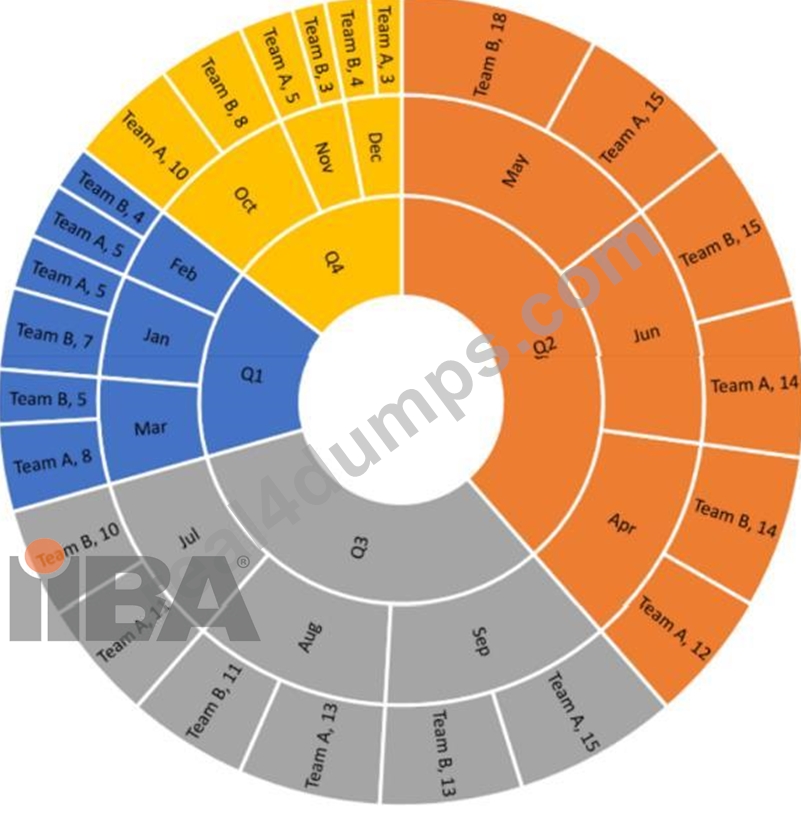
- A. Q4 was the lowest performing quarter with November having the lowest monthly sales in the year
- B. Q3 was the strongest performing quarter with Team A having the top monthly sales in the quarter
- C. Q2 was the strongest performing quarter with Team B having the top monthly sales in May
- D. Q4 was the lowest performing quarter with Team A having the lowest monthly sales in the Quarter
Answer: A
Explanation:
Explanation
The chart visualizes monthly sales data for two teams over a year, divided into quarters. By analyzing the data, it is evident that November (part of Q4) had the lowest monthly sales in the year, making option C correct.
There isn't enough information to verify the performance of individual teams in each quarter as per Business Data Analytics (IIBA®- CBDA) objectives and resources. References:
*[Business Analysis Certification in Data Analytics, CBDA | IIBA®], CBDA Competencies, Domain 4:
Interpret and Report Results
*[Understanding the Guide to Business Data Analytics], page 9
*[CERTIFICATION IN BUSINESS DATA ANALYTICS HANDBOOK - IIBA®], page 8, CBDA Exam Sample Questions and Self-Assessment, Question 7
NEW QUESTION # 57
The results of the data analytics work led to some clear and strongly supported outcomes and the analytics team is very confident in their recommendations; particularly given that the payback on the required changes are a short 3 months. However, there is concern because the organization operates in a highly regulated environment and some new regulatory changes are being considered with announcements and implementation in the next 6 months. Under these conditions the team decides to:
- A. Reassess their results to ensure their validity and then decide what to do
- B. Postpone recommendations for 6 months until the announcements are made
- C. Identify and carefully document assumptions for their recommendation
- D. Recommend no action be taken at this time and revisit in 6 months
Answer: C
Explanation:
The best option for the team under these conditions is to identify and carefully document theassumptions for their recommendation, such as the expected impact of the regulatory changes, the risks and benefits of implementing the changes before or after the announcements, and the sensitivity of the results to different scenarios. This way, the team can communicate their findings and recommendations clearly and transparently, while also acknowledging the uncertainty and limitations of their analysis. This can help the decision makers to evaluate the trade-offs and make informed choices12. References: 1: Guide to Business Data Analytics, IIBA, 2020, p. 242: Data-Driven Decision Making: A Primer for Beginners, Anand Rao, 2018, 1.
NEW QUESTION # 58
To gain traction on online sales, a retailer initiated a marketing campaign using banner ads. The company has requested their analytics team to evaluate the performance of the campaign. During the presentation, the analyst confirmed that the campaign did bring in a large number of net new customers to the website and met the target sales conversion rate. They also noted that there was a high number of repeat visitors not completing a sale. What decision would help the retailer improve sales conversion rates for repeat visitors?
- A. Ensure the sales checkout process is streamlined
- B. Incentivize customers to subscribe to promotional notifications
- C. Add additional new products to attract customers
- D. Increase investment in banner ads
Answer: A
Explanation:
Explanation
According to the Business Data Analytics: A Decision-Making Paradigm1, one of the key steps in the analytics process is to communicate insights and recommendations to stakeholders. The analyst should present the findings in a clear and concise manner, and provide actionable suggestions to improve the business outcomes. In this case, the analyst has identified that repeat visitors are not completing a sale, which indicates a possible issue with the sales checkout process. Therefore, the analyst should recommend the retailer to streamline the sales checkout process, which could reduce friction, increase customer satisfaction, and boost sales conversion rates for repeat visitors. References: Business Data Analytics: A Decision-Making Paradigm
NEW QUESTION # 59
......
CBDA Dumps PDF - Want To Pass CBDA Fast: https://prep4sure.real4dumps.com/CBDA-prep4sure-exam.html
