

The AD0-E720 PDF Dumps Greatest for the Adobe Exam Study Guide!
Read Online AD0-E720 Test Practice Test Questions Exam Dumps
Adobe AD0-E720 Exam Syllabus Topics:
| Topic | Details |
|---|---|
| Topic 1 |
|
| Topic 2 |
|
| Topic 3 |
|
| Topic 4 |
|
| Topic 5 |
|
| Topic 6 |
|
NEW QUESTION # 11
An Adobe Commerce developer wants to override the following Layout XML file in the theme ExampleCorp/orange.
app/design/frontend/ExampleCorp/blank/Vendor_Module/layout/catalog_product_view.xml What path would the developer use inside the layout directory of the theme to override the file?
- A. /override/theme/ExampleCorp/blank/catalog_product_view.xml
- B. /catalog_product_view.xml
- C. /override/ExampleCorp/blank/catalog_product_view.xml
Answer: B
Explanation:
Explanation
To override a layout XML file from a parent theme, the developer just needs to place the modified file in the same path relative to the layout directory of the child theme. In this case, the file would be app/design/frontend/ExampleCorp/orange/Vendor_Module/layout/catalog_product_view.xml. The override directory is not used for overriding layout files, but for overriding templates and web assets. References:
[Layout instructions], [Override templates and layout files]
NEW QUESTION # 12
an Adobe commerce developer wants to override the core Magento Ul library dropdowns in your theme.
Which is the correct way to achieve this?
- A. /web/css/source/lib/.dropdowns.less
- B. lib/web/css/source/.dropdowns.less
- C. /web/css/source/_dropdowns.less
Answer: C
Explanation:
Explanation
To override the core Magento UI library dropdowns in a custom theme, the developer needs to create a file named _dropdowns.less in the /web/css/source directory of the theme. This file will override the default
_dropdowns.less file from the lib/web/css/source/lib directory and apply the custom styles to the dropdown elements. The lib/web/css/source/_dropdowns.less and /web/css/source/lib/_dropdowns.less files are not valid and will not work, as they do not follow the theme structure or the naming convention. References:
[Dropdowns], [Theme structure]
NEW QUESTION # 13
An Adobe Commerce developer has found following code: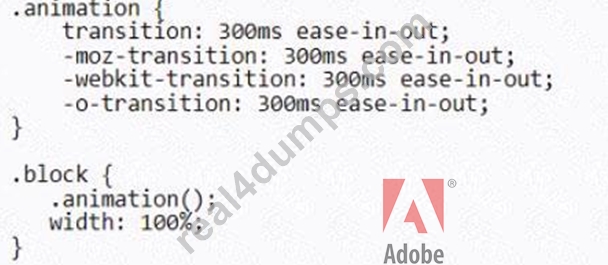
After compiling the .less file into a .ess file, what will be the results of the code above?
- A.
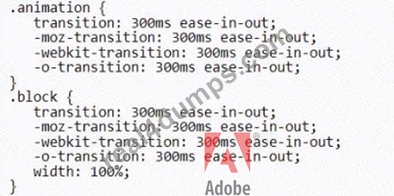
- B.
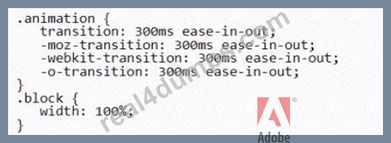
- C.
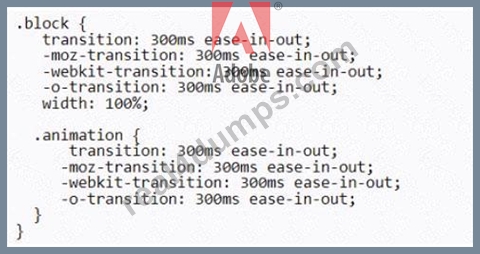
Answer: C
Explanation:
Explanation
After compiling the .less file into a .css file, the result of the code above will be option B. This is because the
.less file uses a mixin called .animation() that takes two parameters: the name of the animation and the duration. The mixin defines a set of vendor-prefixed properties for the animation and assigns them the values of the parameters. For example:
animation(@name; @duration) { -webkit-animation-name: @name; -webkit-animation-duration: @duration;
-moz-animation-name: @name; -moz-animation-duration: @duration; animation-name: @name; animation-duration: @duration; } When the mixin is called with the values "fade" and "2s", it will generate the following CSS code:
-webkit-animation-name: fade; -webkit-animation-duration: 2s; -moz-animation-name: fade;
-moz-animation-duration: 2s; animation-name: fade; animation-duration: 2s; Option A is not correct because it does not use the vendor prefixes for the animation properties. Option C is not correct because it uses the wrong values for the animation name and duration. References: [LESS Mixins],
[CSS Animations]
NEW QUESTION # 14
When using Grunt, which CLI command is used to track changes in the source files and recompiles CSS files?
- A. grunt watch
- B. grunt less
- C. grunt start
Answer: A
Explanation:
Explanation
The grunt watch command is used to track changes in the source files and recompiles CSS files automatically.
This command is useful for frontend development as it allows the developer to see the changes in real time without manually running other commands. The grunt watch command can be run with or without parameters to specify the theme and locale. For example, to track changes for the Vendor/Orange theme and the en_US locale, the developer can use:
grunt watch --theme=Vendor/Orange --locale=en_US
The other two options are incorrect because they do not track changes in the source files. The grunt start command is used to register themes and clear caches before running other commands. The grunt less command is used to compile LESS files to CSS files for a specific theme and locale. References: Adobe Commerce Developer Documentation, Adobe Inc.
NEW QUESTION # 15
An Adobe Commerce developer created a module called Orange_Customer. In customer information.
Where would the developer place this file?
- A. app/code/OrangG/Custon>Gr/viGw/frontGnd/templates/customGr-info.phtml
- B. app/code/OrangG/customer/viev^/frontend/web/templates/customer-info.phtml
- C. app/code/Orange/Customer/frontend/templates/customer-info.phtml
Answer: A
Explanation:
Explanation
To place a template file for a custom module, the developer should follow this path pattern:
app/code/<Vendor>/<Module>/view/<Area>/templates/<Template>
In this case, the vendor name is Orange, the module name is Customer, the area is frontend, and the template name is customer-info.phtml. Therefore, the correct path is:
app/code/Orange/Customer/view/frontend/templates/customer-info.phtml
The following paths are not correct and will not work:
app/code/Orange/customer/view/frontend/web/templates/customer-info.phtml: This path is incorrect because it uses web instead of templates, which is used for storing web assets like CSS, JS, and images, not template files.
app/code/Orange/Customer/frontend/templates/customer-info.phtml: This path is incorrect because it misses the view directory, which is required for separating frontend and backend templates.
NEW QUESTION # 16
An Adobe Commerce developer wants to add a custom widget that extends the default Calendar Widget. What would the contents of this file look like?
- A.
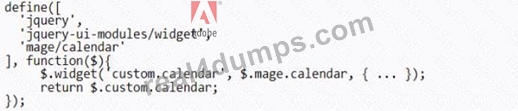
- B.
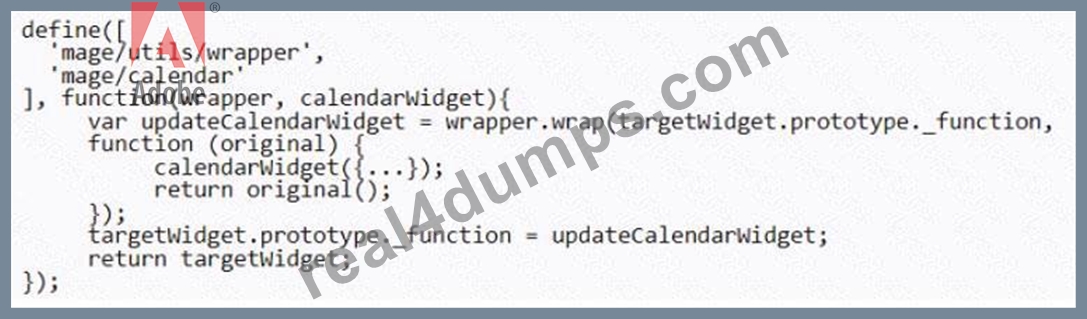
- C.
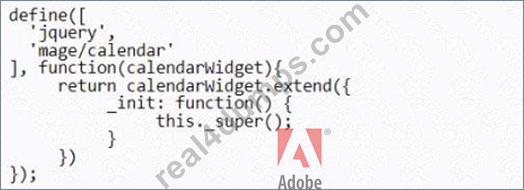
Answer: A
Explanation:
Explanation
To add a custom widget that extends the default Calendar Widget, the contents of the file would look like option B. This is because option B follows the correct syntax and structure for defining a jQuery widget in Magento. The code does the following steps:
Defines a module with the name "Vendor_Module/js/calendar-widget" that depends on the "jquery/ui" and "Magento_Ui/js/lib/knockout/bindings/datepicker" modules.
Returns a function that creates a new widget with the name "vendor.calendarWidget" that extends the base calendar widget class.
Overrides the init function of the base calendar widget class to add custom logic or functionality to the widget.
Option A is not correct because it does not use the correct syntax for defining a jQuery widget. It uses a script tag instead of a define function, which is not valid for creating a module. It also uses an incorrect name for the widget, which should use a dot instead of a slash. Option C is not correct because it does not use the correct syntax for extending a widget. It uses an extend function instead of a widget function, which is not valid for creating a new widget. It also does not return anything from the module, which will cause an error.
References: [jQuery widgets], [Calendar Widget]
NEW QUESTION # 17
An Adobe Commerce developer wants to remove the default Wishlist and Compare Products blocks on a category page with layered navigation Where would this modification be placed, assuming the developer only wants to make this change?
- A. app/design/frontend/Vendor/Theme/Magento_LayeredNavigation/layout/override/catalog_category_view_
- B. app/design/frontend/Vendor/Theme/Magento_Layered.Navigation/layout/catalog_category_view_type_lay
- C. app/design/frontend/Vendor/Theme/Magento_Catalog/layout/catalog_category_view.xml
Answer: B
Explanation:
Explanation
To remove the default Wishlist and Compare Products blocks on a category page with layered navigation, the developer should place the modification in the app/design/frontend/Vendor/Theme/Magento_LayeredNavigation/layout/catalog_category_view_type_layered.x file. This file is specific to the category pages with layered navigation and will override the default layout file from the Magento_LayeredNavigation module. The modification should use the <referenceBlock> tag with the name attribute specifying the name of the block and the remove attribute set to true. For example:
<referenceBlock name="catalog.compare.sidebar" remove="true"/> <referenceBlock name="wishlist_sidebar" remove="true"/> The app/design/frontend/Vendor/Theme/Magento_LayeredNavigation/layout/override/catalog_category_view_type_ file is not valid and will not work, as it is not a valid override path. The app/design/frontend/Vendor/Theme/Magento_Catalog/layout/catalog_category_view.xml file is not specific to the category pages with layered navigation and will affect all category pages. References: [Layout override],
[Remove an element]
NEW QUESTION # 18
In which folder can a custom theme favicon be added?
- A. <your_theme_dir>/Magento_Theme/web/
- B. <your_theme_dir>/assets/images
- C. <your_theme_dir>/web/
Answer: A
Explanation:
Explanation
The favicon can be added to the <your_theme_dir>/Magento_Theme/web/ directory of a custom theme. The favicon should have the name favicon.ico and replace the default one from the Magento_Theme module. The
<your_theme_dir>/web/ directory is used for storing web assets that are not specific to any module. The
<your_theme_dir>/assets/images directory does not exist by default and is not used for storing favicons.
References: [Add a favicon], [Theme structure]
NEW QUESTION # 19
An Adobe Commerce developer is trying to remove a block using the <remove name="test.block'/> tag in a layout XML file but it shows an error and doesn't work.
Which tag would be applied to fix the error?
- A. US6 <referenceBlock name="test.block" remove="true"/>
- B. Use<referenceBlock name="test.block" delete="true'7>
- C. Use <remove name="Custom_Module:test.block"/>
Answer: A
Explanation:
Explanation
To remove a block using layout XML, the developer should use the <referenceBlock> tag with the name attribute specifying the name of the block and the remove attribute set to true. For example:
<referenceBlock name="test.block" remove="true"/>
This will remove the block from the layout and prevent it from rendering. The <remove> tag is not valid and will cause an error. The name attribute should not include the module name, as it is not part of the block name.
The delete attribute is not valid and will not work. References: [Layout instructions], [Remove an element]
NEW QUESTION # 20
An Adobe Commerce developer needs to create translations for the Orange/custom theme. Which directory would the developer place the translations?
- A. Orange/custom/etc
- B. Orange/custom/translations
- C. Orange/custom/il8n
Answer: C
Explanation:
Explanation
To create translations for a theme, the developer needs to place the translation files in the il8n directory of the theme. The translation files should have the format <language code>_<country code>.csv, such as en_US.csv or fr_FR.csv. The etc and translations directories are not used for storing translation files. References:
[Translations overview], [Translate theme strings]
NEW QUESTION # 21
An Adobe Commerce developer has been asked to add text to an email template that supports translations.
Which two options would they use during their implementation? (Choose two.)
- A. {{trans "Lorem Ipsum is simply dummy text of the printing"}}
- B. {{translations "Lorem Ipsum is simply dummy text of the printing"}}
- C. {{trans "%items items" items="numltems"}}
- D. {{translations "%items items" items="numltems"}}
Answer: C,D
Explanation:
Explanation
To add text to an email template that supports translations, the developer should use the {{trans}} directive with the text enclosed in double quotes. For example:
{{trans "Lorem Ipsum is simply dummy text of the printing"}}
This will render the text as it is, or translate it if a translation file is available for the current locale. If the text contains a variable, the developer should use a placeholder with a percent sign and pass the variable name as an argument. For example:
{{trans "%items items" items="numItems"}}
This will render the text with the value of numItems replacing the %items placeholder, or translate it if a translation file is available for the current locale. The {{translations}}directive is not valid and will not work.
References: [Translate email templates], [Email template syntax]
NEW QUESTION # 22
An Adobe Commerce developer has just installed an extension via composer. When running, bin/magento module: status Vendor_Module, the status is returned as Module is disabled.
Which two CLI commands need to be run to make the extension work properly? (Choose two.)
- A. bin/magento module:enable Vendor_Module --clear-static-content
- B. bin/magento setup:upgrade
- C. composer install
- D. composer update vendor/module
Answer: A,B
Explanation:
Explanation
The developer needs to run these two CLI commands to make the extension work properly:
bin/magento module:enable Vendor_Module --clear-static-content This command enables the extension and clears any outdated static files that might interfere with its functionality.
bin/magento setup:upgrade This command updates the database schema and data according to the extension's requirements. The other two options are incorrect because they are not necessary to make the extension work properly. The composer install command installs all dependencies specified in the composer.json file, but it does not enable or update any extensions. The composer update vendor/module command updates an existing extension to its latest version, but it does not enable or upgrade it.
NEW QUESTION # 23
An Adobe Commerce developer is extending a theme from Magento\blank and wants to override parent styles.
Which file does the developer need to change to override the parent theme styles?
- A. web/css/source/_theme. less
- B. web/css/source/_extends.less
- C. web/css/source/_extend.less
Answer: C
Explanation:
Explanation
To override the parent theme styles, the developer needs to change the web/css/source/_extend.less file in the child theme. This file is used to import and extend the parent theme styles without modifying the original files.
The developer can use the @import directive to import the parent theme styles and then use the .lib-css() mixin to override the CSS properties. For example:
@import 'source/_extend.less'; // Import parent theme styles .lib-css(color, red); // Override color property The web/css/source/_extends.less and web/css/source/_theme.less files are not valid and will not work, as they do not follow the theme structure or the naming convention. References: [Theme inheritance], [Extend parent theme styles]
NEW QUESTION # 24
Adobe commerce fronted developer needs to speed up the cloud environment deployment process with predefined theme languages for reducing the number of unnecessary themes files.
Which place developer should add language codes?
- A. scopes section in config.php file
- B. relationships property in .magento.app.yaral file
- C. SCD_matrix deploy variable in .magento.env.yaml file
Answer: C
Explanation:
Explanation
The SCD_matrix deploy variable in the .magento.env.yaml file is used to speed up the cloud environment deployment process by specifying the theme languages for each theme. This reduces the number of unnecessary theme files that are generated during the static content deployment. The developer can add the language codes for each theme in the following format:
SCD_MATRIX: <theme>: <languages>
For example, to specify English and French languages for the Vendor/Orange theme, the developer can use:
SCD_MATRIX: Vendor/Orange: en_US,fr_FR
The other two options are incorrect because they are not related to the theme languages or the static content deployment. The relationships property in the .magento.app.yaml file is used to define how services are connected to the application. The scopes section in the config.php file is used to specify the configuration scope of each module. References: Adobe Commerce Developer Documentation, Adobe Inc.
NEW QUESTION # 25
An Adobe Commerce developer needs to debug an issue, where the path of the block template was invalid and the warning was added to a log file. Which mode are errors only written to a log file and not displayed?
- A. developer and default
- B. developer only
- C. default and production
Answer: C
Explanation:
Explanation
The default and production modes are the modes where errors are only written to a log file and not displayed on the screen. This is done to prevent exposing sensitive information to users and attackers. The default mode is the mode that Adobe Commerce runs in by default if no other mode is specified. The production mode is the mode that Adobe Commerce runs in when it is deployed to a live site. The developer can use the following command to check the current mode:
bin/magento deploy:mode:show
The other two options are incorrect because they display errors on the screen as well as writing them to a log file. The developer mode is the mode that Adobe Commerce runs in when it is under development or testing.
The developer mode enables enhanced debugging and error reporting features. References: Adobe Commerce Developer Documentation, Adobe Inc.
NEW QUESTION # 26
An Adobe Commerce developer wants to determine which template is rendering a specific element on the storefront. Which two methods can they use to turn on template hints? (Choose two.)
- A. On the command line, run the command; php bin/magento dev:template-hints:enable
- B. On the command line, run the command; php bin/magento setup:enable-template-hints
- C. In the Admin, navigate to system > Advanced > Template > Developer > Debug.
Set Enabled Template Path Hints for Storefront to Yes - D. In the Admin, navigate to Stores > Configuration > Advanced > Developer > Debug.
Set Enabled Template Path Hints for Storefront to Yes
Answer: A,D
Explanation:
Explanation
Template hints are a useful tool for frontend developers to determine which template is rendering a specific element on the storefront. Template hints can be turned on using either of these two methods:
In the Admin Panel, navigate to Stores > Configuration > Advanced > Developer > Debug. Set Enabled Template Path Hints for Storefront to Yes On the command line, run the command; php bin/magento dev:template-hints:enable The other two options are incorrect because they do not exist as valid methods to turn on template hints.
References: Adobe Commerce Developer Documentation, Adobe Inc.
NEW QUESTION # 27
......
AD0-E720 Certification All-in-One Exam Guide Jan-2024: https://prep4sure.real4dumps.com/AD0-E720-prep4sure-exam.html
