

100% Pass Your DP-100 Exam Dumps at First Attempt with Real4dumps
Penetration testers simulate DP-100 exam PDF
The DP-100 exam is a popular choice for data scientists looking to broaden their skillset and stay relevant in the field. It covers topics such as data exploration and preparation, data storage and processing, machine learning model development, and deployment. Additionally, the exam also tests the candidate's understanding of data security, compliance, and ethical considerations.
NEW QUESTION # 221
You need to set up the Permutation Feature Importance module according to the model training requirements.
Which properties should you select? To answer, select the appropriate options in the answer area.
NOTE: Each correct selection is worth one point.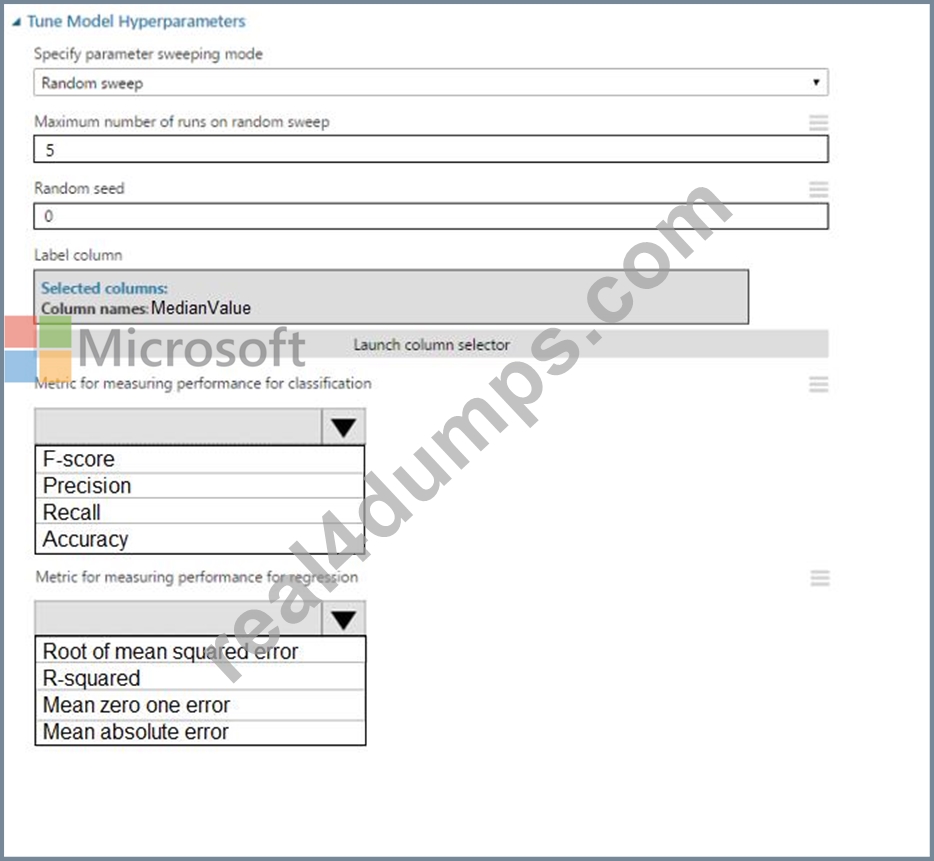
Answer:
Explanation:
NEW QUESTION # 222
Note: This question is part of a series of questions that present the same scenario. Each question in the series contains a unique solution that might meet the stated goals. Some question sets might have more than one correct solution, while others might not have a correct solution.
After you answer a question in this section, you will NOT be able to return to it. As a result, these questions will not appear in the review screen.
You train and register a machine learning model.
You plan to deploy the model as a real-time web service. Applications must use key-based authentication to use the model.
You need to deploy the web service.
Solution:
Create an AksWebservice instance.
Set the value of the auth_enabled property to False.
Set the value of the token_auth_enabled property to True.
Deploy the model to the service.
Does the solution meet the goal?
- A. No
- B. Yes
Answer: A
Explanation:
Explanation
Instead use only auth_enabled = TRUE
Note: Key-based authentication.
Web services deployed on AKS have key-based auth enabled by default. ACI-deployed services have key-based auth disabled by default, but you can enable it by setting auth_enabled = TRUE when creating the ACI web service. The following is an example of creating an ACI deployment configuration with key-based auth enabled.
deployment_config <- aci_webservice_deployment_config(cpu_cores = 1,
memory_gb = 1,
auth_enabled = TRUE)
Reference:
https://azure.github.io/azureml-sdk-for-r/articles/deploying-models.html
NEW QUESTION # 223
You are hired as a data scientist at a winery. The previous data scientist used Azure Machine Learning.
You need to review the models and explain how each model makes decisions.
Which explainer modules should you use? To answer, select the appropriate options in the answer area.
NOTE: Each correct selection is worth one point.
Answer:
Explanation:
Reference:
https://medium.com/microsoftazure/automated-and-interpretable-machine-learning-d07975741298
NEW QUESTION # 224
You create an Azure Data Lake Storage Gen2 stowage account named storage1 containing a file system named fsi and a folder named folder1.
The contents of folder1 must be accessible from jobs on compute targets in the Azure Machine Learning workspace.
You need to construct a URl to reference folder1.
How should you construct the URI? To answer, select the appropriate options in the answer area.
NOTE: Each correct selection is worth one point.
Answer:
Explanation:
NEW QUESTION # 225
You train and register a model by using the Azure Machine Learning SDK on a local workstation. Python 3.6 and Visual Studio Code are installed on the workstation.
When you try to deploy the model into production as an Azure Kubernetes Service (AKS)-based web service, you experience an error in the scoring script that causes deployment to fail.
You need to debug the service on the local workstation before deploying the service to production.
Which four actions should you perform in sequence? To answer, move the appropriate actions from the list of actions to the answer area and arrange them in the correct order.

Answer:
Explanation:
1 - Install Docker on the workstation
2 - Create an AksWebservice deployment configuration and deploy the model to it
3 - Create a LocalWebservice deployment configuration for the service and deploy the model to it
4 - Debug and modify the scoring script as necessary. Use the reload() method of the service after each modification.
Reference:
https://docs.microsoft.com/en-us/azure/machine-learning/how-to-deploy-azure-kubernetes-service
https://docs.microsoft.com/en-us/azure/machine-learning/how-to-troubleshoot-deployment-local
NEW QUESTION # 226
You have an Azure Machine Learning workspace
You plan to use the Azure Machine Learning SDK for Python v1 to submit a job to run a training script.
You need to complete the script to ensure that it will execute the training script.
How should you complete the script? To answer, select the appropriate options in the answer area.
NOTE: Each correct selection is worth one point
Answer:
Explanation:
NEW QUESTION # 227
You create a script for training a machine learning model in Azure Machine Learning service.
You create an estimator by running the following code:
For each of the following statements, select Yes if the statement is true. Otherwise, select No.
NOTE: Each correct selection is worth one point.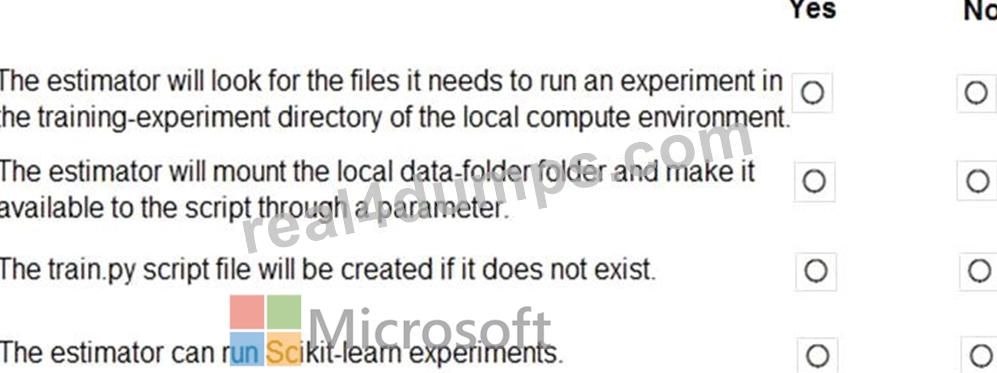
Answer:
Explanation:
Explanation
Box 1: Yes
Parameter source_directory is a local directory containing experiment configuration and code files needed for a training job.
Box 2: Yes
script_params is a dictionary of command-line arguments to pass to the training script specified in entry_script.
Box 3: No
Box 4: Yes
The conda_packages parameter is a list of strings representing conda packages to be added to the Python environment for the experiment.
NEW QUESTION # 228
You register a file dataset named csvjolder that references a folder. The folder includes multiple com ma-separated values (CSV) files in an Azure storage blob container. You plan to use the following code to run a script that loads data from the file dataset. You create and instantiate the following variables:
You have the following code:

You need to pass the dataset to ensure that the script can read the files it references. Which code segment should you insert to replace the code comment?
- A.

- B.

- C.

- D.

Answer: D
Explanation:
Example:
from azureml.train.estimator import Estimator
script_params = {
# to mount files referenced by mnist dataset
'--data-folder': mnist_file_dataset.as_named_input('mnist_opendataset').as_mount(),
'--regularization': 0.5
}
est = Estimator(source_directory=script_folder,
script_params=script_params,
compute_target=compute_target,
environment_definition=env,
entry_script='train.py')
Reference:
https://docs.microsoft.com/en-us/azure/machine-learning/tutorial-train-models-with-aml
NEW QUESTION # 229
Note: This question is part of a series of questions that present the same scenario. Each question in the series contains a unique solution that might meet the stated goals. Some question sets might have more than one correct solution, while others might not have a correct solution.
After you answer a question in this section, you will NOT be able to return to it as a result, these questions will not appear in the review screen.
You use Azure Machine Learning designer to load the following datasets into an experiment:
You need to create a dataset that has the same columns and header row as the input datasets and contains all rows from both input datasets.
Solution: Use the Apply Transformation module.
Does the solution meet the goal?
- A. No
- B. Yes
Answer: A
NEW QUESTION # 230
You use Azure Machine Learning to train and register a model.
You must deploy the model into production as a real-time web service to an inference cluster named service-compute that the IT department has created in the Azure Machine Learning workspace.
Client applications consuming the deployed web service must be authenticated based on their Azure Active Directory service principal.
You need to write a script that uses the Azure Machine Learning SDK to deploy the model. The necessary modules have been imported.
How should you complete the code? To answer, select the appropriate options in the answer area.
NOTE: Each correct selection is worth one point.
Answer:
Explanation:
Reference:
https://docs.microsoft.com/en-us/azure/machine-learning/how-to-deploy-azure-kubernetes-service
https://docs.microsoft.com/en-us/azure/databricks/dev-tools/api/latest/aad/service-prin-aad-token
NEW QUESTION # 231
You need to build a feature extraction strategy for the local models.
How should you complete the code segment? To answer, select the appropriate options in the answer area.
NOTE: Each correct selection is worth one point.
Answer:
Explanation:
Explanation
NEW QUESTION # 232
You publish a batch inferencing pipeline that will be used by a business application.
The application developers need to know which information should be submitted to and returned by the REST interface for the published pipeline.
You need to identify the information required in the REST request and returned as a response from the published pipeline.
Which values should you use in the REST request and to expect in the response? To answer, select the appropriate options in the answer area.
NOTE: Each correct selection is worth one point.
Answer:
Explanation:
Reference:
https://docs.microsoft.com/en-us/azure/machine-learning/tutorial-pipeline-batch-scoring-classification
NEW QUESTION # 233
You need to configure the Edit Metadata module so that the structure of the datasets match.
Which configuration options should you select? To answer, select the appropriate options in the answer area.
NOTE: Each correct selection is worth one point.
Answer:
Explanation:
Explanation:
Box 1: Floating point
Need floating point for Median values.
Scenario: An initial investigation shows that the datasets are identical in structure apart from the MedianValue column. The smaller Paris dataset contains the MedianValue in text format, whereas the larger London dataset contains the MedianValue in numerical format.
Box 2: Unchanged
Note: Select the Categorical option to specify that the values in the selected columns should be treated as categories.
For example, you might have a column that contains the numbers 0,1 and 2, but know that the numbers actually mean "Smoker", "Non smoker" and "Unknown". In that case, by flagging the column as categorical you can ensure that the values are not used in numeric calculations, only to group data.
NEW QUESTION # 234
You need to configure the Feature Based Feature Selection module based on the experiment requirements and datasets.
How should you configure the module properties? To answer, select the appropriate options in the dialog box in the answer area.
NOTE: Each correct selection is worth one point.
Answer:
Explanation: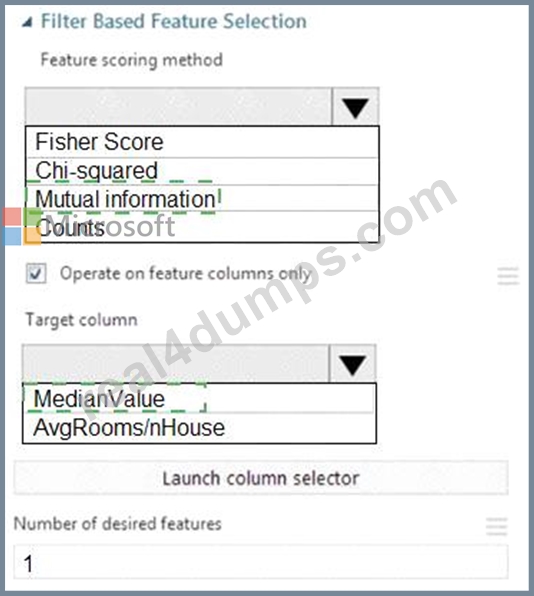
Explanation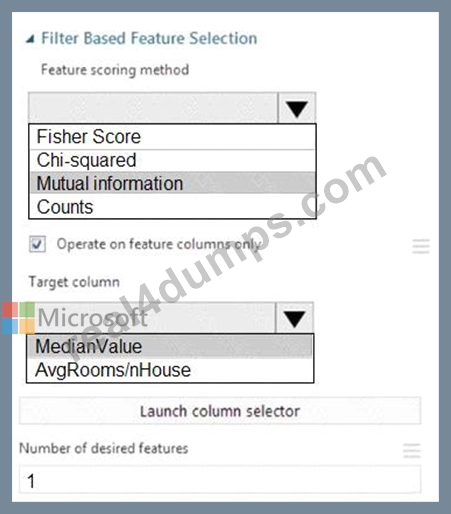
Box 1: Mutual Information.
The mutual information score is particularly useful in feature selection because it maximizes the mutual information between the joint distribution and target variables in datasets with many dimensions.
Box 2: MedianValue
MedianValue is the feature column, , it is the predictor of the dataset.
Scenario: The MedianValue and AvgRoomsinHouse columns both hold data in numeric format. You need to select a feature selection algorithm to analyze the relationship between the two columns in more detail.
References:
https://docs.microsoft.com/en-us/azure/machine-learning/studio-module-reference/filter-based-feature-selection
NEW QUESTION # 235
You need to modify the inputs for the global penalty event model to address the bias and variance issue.
Which three actions should you perform in sequence? To answer, move the appropriate actions from the list of actions to the answer area and arrange them in the correct order.
Answer:
Explanation:
NEW QUESTION # 236
You are building recurrent neural network to perform a binary classification.
The training loss, validation loss, training accuracy, and validation accuracy of each training epoch has been provided. You need to identify whether the classification model is over fitted.
Which of the following is correct?
- A. The training loss .stays constant and the validation loss stays on a constant value and close to the training loss value when training the model.
- B. The training loss stays constant and the validation loss decreases when training the model.
- C. The training loss increases while the validation loss decreases when training the model.
- D. The training loss decreases while the validation loss increases when training the model.
Answer: D
Explanation:
An overfit model is one where performance on the train set is good and continues to improve, whereas performance on the validation set improves to a point and then begins to degrade.
Reference:
https://machinelearningmastery.com/diagnose-overfitting-underfitting-lstm-models/
NEW QUESTION # 237
You create an Azure Machine Learning workspace named workspace1. You assign a custom role to a user of workspace1.
The custom role has the following JSON definition:
Instructions: For each of the following statements, select Yes if the statement is true. Otherwise, select No.
NOTE: Each correct selection is worth one point.
Answer:
Explanation:
Reference:
https://docs.microsoft.com/en-us/azure/role-based-access-control/overview#how-azure-rbac-determines-if-a-user-has-access-to-a-resource
NEW QUESTION # 238 
You must use the Azure Machine Learning SDK to interact with data and experiments in the workspace.
You need to configure the config.json file to connect to the workspace from the Python environment.
Which two additional parameters must you add to the config.json file in order to connect to the workspace?
Each correct answer presents part of the solution.
NOTE: Each correct selection is worth one point.
- A. Login
- B. Key
- C. subscription_Id
- D. region
- E. resource_group
Answer: C,E
Explanation:
Explanation
To use the same workspace in multiple environments, create a JSON configuration file. The configuration file saves your subscription (subscription_id), resource (resource_group), and workspace name so that it can be easily loaded.
The following sample shows how to create a workspace.
from azureml.core import Workspace
ws = Workspace.create(name='myworkspace',
subscription_id='<azure-subscription-id>',
resource_group='myresourcegroup',
create_resource_group=True,
location='eastus2'
)
Reference:
https://docs.microsoft.com/en-us/python/api/azureml-core/azureml.core.workspace.workspace
NEW QUESTION # 239
You are performing feature engineering on a dataset.
You must add a feature named CityName and populate the column value with the text London.
You need to add the new feature to the dataset.
Which Azure Machine Learning Studio module should you use?
- A. Edit Metadata
- B. Execute Python Script
- C. Preprocess Text
- D. Latent Dirichlet Allocation
Answer: A
Explanation:
Explanation
Typical metadata changes might include marking columns as features.
References:
https://docs.microsoft.com/en-us/azure/machine-learning/studio-module-reference/edit-metadata
NEW QUESTION # 240
You create machine learning models by using Azure Machine Learning.
You plan to train and score models by using a variety of compute contexts. You also plan to create a new compute resource in Azure Machine Learning studio.
You need to select the appropriate compute types.
Which compute types should you select? To answer, drag the appropriate compute types to the correct requirements. Each compute type may be used once, more than once, or not at all. You may need to drag the split bar between panes or scroll to view content.
NOTE: Each correct selection is worth one point.
Answer:
Explanation:
NEW QUESTION # 241
You are producing a multiple linear regression model in Azure Machine Learning Studio.
Several independent variables are highly correlated.
You need to select appropriate methods for conducting effective feature engineering on all the data.
Which three actions should you perform in sequence? To answer, move the appropriate actions from the list of actions to the answer area and arrange them in the correct order.
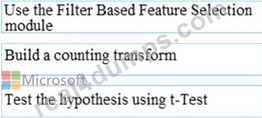
Answer:
Explanation:
1 - Use the Filter Based Feature Selection module
2 - Build a counting transform
3 - Test the hypothesis using t-Test
References:
https://docs.microsoft.com/bs-latn-ba/azure/machine-learning/studio-module-reference/filter-based-feature-selection
https://docs.microsoft.com/bs-latn-ba/azure/machine-learning/studio-module-reference/filter-based-feature-selection https://docs.microsoft.com/en-us/azure/machine-learning/studio-module-reference/build-counting-transform
https://docs.microsoft.com/bs-latn-ba/azure/machine-learning/studio-module-reference/filter-based-feature-selection https://docs.microsoft.com/en-us/azure/machine-learning/studio-module-reference/build-counting-transform
https://docs.microsoft.com/en-us/azure/machine-learning/studio-module-reference/build-counting-transform
NEW QUESTION # 242
You need to define an evaluation strategy for the crowd sentiment models.
Which three actions should you perform in sequence? To answer, move the appropriate actions from the list of actions to the answer area and arrange them in the correct order.
Answer:
Explanation:
Explanation:
Scenario:
Experiments for local crowd sentiment models must combine local penalty detection data.
Crowd sentiment models must identify known sounds such as cheers and known catch phrases. Individual crowd sentiment models will detect similar sounds.
Note: Evaluate the changed in correlation between model error rate and centroid distance In machine learning, a nearest centroid classifier or nearest prototype classifier is a classification model that assigns to observations the label of the class of training samples whose mean (centroid) is closest to the observation.
References:
https://en.wikipedia.org/wiki/Nearest_centroid_classifier
https://docs.microsoft.com/en-us/azure/machine-learning/studio-module-reference/sweep-clustering
NEW QUESTION # 243
You are developing a machine learning, experiment by using Azure. The following images show the input and output of a machine learning experiment:
Use the drop-down menus to select the answer choice that answers each question based on the information presented in the graphic.
NOTE: Each correct selection is worth one point.
Answer:
Explanation:
NEW QUESTION # 244
Note: This question is part of a series of questions that present the same scenario. Each question in the series contains a unique solution that might meet the stated goals. Some question sets might have more than one correct solution, while others might not have a correct solution.
After you answer a question in this section, you will NOT be able to return to it. As a result, these questions will not appear in the review screen.
An IT department creates the following Azure resource groups and resources:
The IT department creates an Azure Kubernetes Service (AKS)-based inference compute target named aks-cluster in the Azure Machine Learning workspace.
You have a Microsoft Surface Book computer with a GPU. Python 3.6 and Visual Studio Code are installed.
You need to run a script that trains a deep neural network (DNN) model and logs the loss and accuracy metrics.
Solution: Install the Azure ML SDK on the Surface Book. Run Python code to connect to the workspace and then run the training script as an experiment on local compute.
- A. No
- B. Yes
Answer: A
NEW QUESTION # 245
......
Microsoft DP-100 certification exam is a highly recognized certification in the field of data science. It is designed to provide candidates with the skills and knowledge they need to design and implement data science solutions using Azure technologies. By achieving this certification, candidates can demonstrate their expertise in the field, and enhance their career prospects by opening up new opportunities in the industry.
All DP-100 Dumps and Training Courses: https://prep4sure.real4dumps.com/DP-100-prep4sure-exam.html
