

Latest Mar 28, 2026 Real AB-100 Exam Dumps Questions Valid AB-100 Dumps PDF
Microsoft AB-100 Exam Dumps - PDF Questions and Testing Engine
NEW QUESTION # 38
Scenario: You are in the process of adding an existing critical backend service (e.g., for inventory management or order fulfillment) to an agent being built in Microsoft Copilot Studio. The goal is for the agent to effectively use this service for retrieving inventory levels, updating records, and executing specific business logic on behalf of the user.
What is the essential requirement for successfully integrating this backend service so the agent can reliably consume its capabilities within Microsoft Copilot Studio?
- A. The service must run exclusively on Azure Kubernetes Service (AKS)
- B. The service must be entirely rewritten using Azure Functions
- C. The service must expose an MCP-compliant interface for the agent to consume
- D. The agent must be configured to accept only text-based prompts
Answer: C
Explanation:
The service must expose an MCP-compliant interface for the agent to consume is correct because - Microsoft's strategy for agent interoperability, especially within the Copilot ecosystem (including Copilot Studio), heavily relies on the Model Context Protocol (MCP). For an agent to understand and reliably interact with a backend service to perform actions, that service needs to expose its capabilities (functions, parameters, descriptions) in an MCP-compliant manner.
References:
https://learn.microsoft.com/en-us/agent-framework/overview/agent-framework-overview
https://learn.microsoft.com/en-us/microsoft-copilot-studio/mcp-add-existing-server-to-agent
NEW QUESTION # 39
A company has an AI solution that uses Azure OpenAI models.
You need to recommend a governance solution that monitors and audits changes to model configurations and data usage. The solution must minimize administrative effort.
What should you include in the recommendation?
- A. Microsoft Purview
- B. Azure API Management
- C. Azure Policy
- D. Azure Stream Analytics
- E. Azure Monitor
Answer: E
Explanation:
Azure Monitor is the primary service for monitoring and auditing Azure OpenAI model configurations and data usage. By combining Azure Monitor with diagnostic settings, you can track management operations, analyze token consumption, and audit prompt/response data.
Reference:
https://learn.microsoft.com/en-us/azure/azure-monitor/fundamentals/overview
NEW QUESTION # 40
Note: This section contains one or more sets of questions with the same scenario and problem. Each question presents a unique solution to the problem. You must determine whether the solution meets the stated goals. More than one solution in the set might solve the problem. It is also possible that none of the solutions in the set solve the problem.
After you answer a question in this section, you will NOT be able to return. As a result, these questions do not appear on the Review Screen.
A company uses Microsoft 365 and Dynamics 365.
You need to recommend a solution to automatically summarize email threads, generate suggested replies in Microsoft Outlook, and provide meeting preparation summaries that include relevant customer relationship management (CRM) data.
Solution: You recommend a Microsoft 365 Copilot agent template.
Does this meet the goal?
- A. No
- B. Yes
Answer: A
Explanation:
Correct:
* You recommend Microsoft 365 Copilot for Sales.
Incorrect:
* You recommend a classic Microsoft Dataverse workflow.
* You recommend a Microsoft 365 Copilot agent template.
Note:
In the described scenario, Microsoft 365 Copilot for Sales acts as the primary bridge between your productivity tools and CRM data. It integrates directly into Microsoft Outlook and Teams to surface real-time insights from Dynamics 365 Sales or Salesforce.
Key capabilities for this specific workflow include:
Automated Email Summarization: Copilot scans long email threads in Outlook to extract key points, highlights, and BANT (Budget, Authority, Need, Timeline) data. If the sender is an external contact recognized in your CRM, the summary is automatically enriched with relevant account and opportunity data.
Suggested Email Replies: When replying to customer emails, Copilot generates drafts based on the context of the conversation and existing CRM data. You can use predefined response categories (e.g., "Reply to an inquiry," "Offer a proposal") or custom prompts to include specific opportunity details in the draft.
Meeting Preparation Summaries: Before a scheduled meeting, Copilot for Sales provides a
"preparation card" in Teams or Outlook. This summary includes:
- CRM Data: Matched opportunity and account attributes.
- Contextual History: Summaries of past email exchanges and the last three seller notes.
- Strategic Insights: Key risks, follow-up actions, and discussion points from previous interactions.
Reference:
https://msdynamicsworld.com/blog/microsoft-copilot-sales-close-deals-faster-ai
NEW QUESTION # 41
Drag and Drop Question
You need to design a Microsoft Copilot Studio agent that meets the following requirements:
- Supports interactive speech responses
- Optimizes decision-making and the accuracy of responses
What should you include in the design for each requirement? To answer, drag the appropriate options to the correct requirements. Each option may be used once, more than once, or not at all. You may need to drag the split bar between panes or scroll to view content.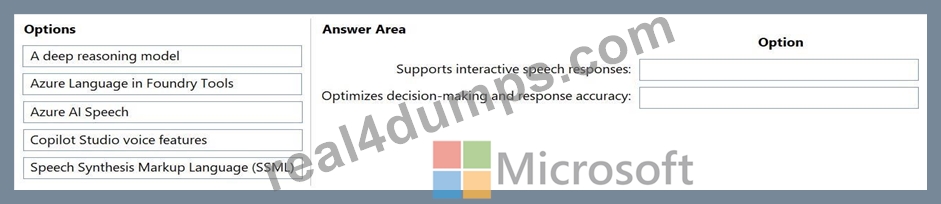
Answer:
Explanation: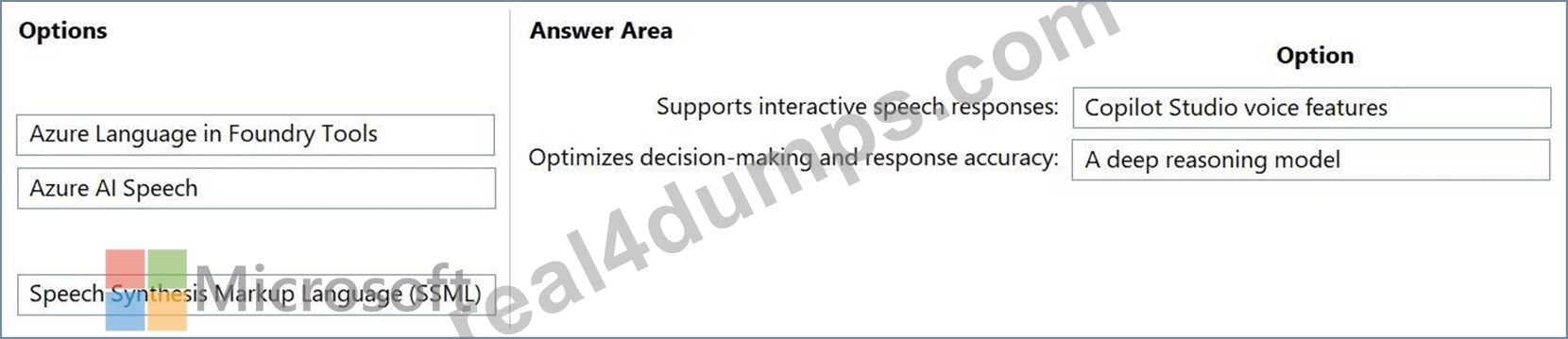
Explanation:
Box 1: Copilot Studio voice features
Supports interactive speech responses
To support interactive speech responses in a Microsoft Copilot Studio agent, you must incorporate specialized voice features and capabilities. These features enable the agent to move beyond chat-based interactions to handle voice-based input (speech-to-text) and output (text-to- speech).
Box 2: A deep reasoning model
Optimizes decision-making and the accuracy of responses
Integrating a deep reasoning model (specifically Azure OpenAI o3) into Microsoft Copilot Studio optimizes decision-making and accuracy by enabling multi-step analysis, logical deduction, and the handling of complex, multi-turn conversations. This capability, enabled via the "reason" keyword in instructions, allows agents to analyze large datasets and provide context-aware, transparent answers, ideal for scenarios like financial analysis or compliance.
Reference:
https://learn.microsoft.com/en-us/microsoft-copilot-studio/voice-overview
https://learn.microsoft.com/en-us/microsoft-copilot-studio/faqs-reasoning
NEW QUESTION # 42
A financial services company uses Microsoft Dynamics 365 Finance.
Currently, the company's support staff manually reviews customer transaction histories to detect potential fraud cases before escalating the cases.
You need to recommend an automation solution for the review process. The solution must ensure that escalations reach a human analyst for final decision making. What should you recommend?
- A. Export the data to a data lake for analysis in Microsoft Power BI.
- B. Configure a task agent to generate fraud risk scores for the human analyst to review.
- C. Deploy an autonomous agent that closes non-fraud cases automatically.
- D. Use Microsoft 365 Copilot in Word to automatically finalize fraud detection policies.
Answer: B
Explanation:
To automate the fraud review process in Microsoft Dynamics 365 Finance while ensuring a human analyst makes the final decision, you should configure the Dynamics 365 Fraud Protection (or integrated Copilot AI agents) to generate risk scores and route high-risk transactions to a manual review queue.
Here is the configuration approach to achieve this:
1. Implement AI-Driven Risk Scoring: Utilize Dynamics 365 Fraud Protection, which uses AI to analyze customer transaction history and assign a risk score (0-999) to each transaction.
2. Define Rules for Escalation: Set up fraud rules in the system to determine which transactions require human intervention. For instance, define a threshold (e.g., a "Minimum score value") where transactions with high fraud probability are automatically flagged.
3. Establish Manual Review Queues: Configure the Manual Review tool to create queues for suspected fraudulent transactions, allowing human analysts to review the AI-generated risk score and transaction history, such as customer behavior, for final, informed decision-making.
4. Use Copilot/AI Agents for Monitoring: Enable AI agents to continuously monitor financial data, such as invoice, payment, and vendor data, and generate alerts for unusual patterns before escalating.
This setup, particularly through the Manual Review workspace, allows for an automated, intelligent, and scalable approach to fraud management.
Reference:
https://www.microsoft.com/en-us/dynamics-365/blog/it-professional/2021/03/25/enhance-your- fraud-workflow-efficiency-with-manual-review/
NEW QUESTION # 43
A company plans to deploy an AI-based customer service app that will autonomously manage interactions, escalate complex cases, and learn from historical ticket data.
You need to perform a return on AI investment (ROAI) analysis of the app deployment. The solution must ensure that the analysis is accurate.
What should you do first?
- A. Conduct an AI market benchmarking study.
- B. Establish the AI performance metrics.
- C. Model the customer experience.
- D. Identify and quantify all the development, deployment, and operating costs.
Answer: D
Explanation:
To conduct a robust Return on AI Investment (ROAI) analysis for your Microsoft-based AI customer service application, you must first categorize and quantify three distinct cost phases:
Development, Deployment, and Operations. For a system capable of managing complex escalations and learning from historical data, your project aligns with "Advanced" or "Agentic" AI profiles.
1. Development Costs (Upfront Investment)
This phase covers the creation of the core AI logic, custom integrations, and data preparation.
2. Deployment Costs (One-Time Setup)
These are the costs to move the application from a development environment to a live production state.
3. Operating & Maintenance Costs (Recurring)
Ongoing expenses are critical for ROAI as they impact the net gain over time.
Reference:
https://emerline.com/blog/ai-app-development-cost
NEW QUESTION # 44
A company has a customer order system that creates sales orders manually.
You need to design an AI solution to automate the following tasks as part of the system:
- Save the order details to a database.
- Update the order status in the database.
- Extract the order details from an order file.
- Prepare and send a confirmation email to customers.
The solution must minimize development effort and support intelligent automation and solution integration.
What should you include in the design?
- A. a multi-agent solution that uses the Semantic Kernel SDK
- B. a multi-agent solution that uses Microsoft Foundry Agent Service
- C. a workflow in Azure Logic Apps
- D. a Microsoft Copilot Studio agent that uses Microsoft Power Automate workflows
Answer: D
Explanation:
To create this system, you'll need to integrate Microsoft Copilot Studio with Power Automate and AI Builder. This combination allows your agent to not only "talk" but also "act" by executing complex backend workflows.
Solution Architecture
Front-end: A Copilot Studio agent serves as the interface, receiving order requests or files from customers.
Brain (Logic): Power Automate cloud flows act as the "skills" for your agent, handling all database and email operations.
Data Extraction: AI Builder (Document Processing) extracts specific fields (like Item ID, Quantity, or Customer Name) from uploaded order files.
Storage: Microsoft Dataverse or SQL Server functions as the database to save and update order records.
Reference:
https://medium.com/@sushmita.sg/build-an-ai-powered-customer-support-system-in-2-hours-no- code-using-microsoft-copilot-2e3275dbbee5
NEW QUESTION # 45
A company has an AI solution built by using Microsoft Copilot Studio and Power Platform. The solution is used by the company's sales, marketing, and customer service teams.
You are performing a return on AI investment (ROAI) analysis to evaluate the impact of the solution.
You need to identify which measurable business drivers to include in the analysis.
Which two business drivers should you identify? Each correct answer presents part of the solution.
NOTE: Each correct selection is worth one point.
- A. brand awareness
- B. increased employee productivity
- C. economic market predictability
- D. the reduced average case resolution time
- E. market capitalization
Answer: B,D
Explanation:
Reducing the average case resolution time is a high-impact, measurable business driver for an AI investment (ROAI) analysis, particularly when implementing Microsoft Copilot Studio and Power Platform for local sales, marketing, and customer service teams.
According to Microsoft and industry research, this metric directly translates to reduced operational costs, increased agent productivity, and higher customer satisfaction.
Increased employee productivity is a primary and highly measurable business driver for an AI investment (ROAI) analysis involving Microsoft Copilot Studio and Power Platform, particularly for sales, marketing, and customer service teams. These tools allow organizations to automate manual tasks, streamline workflows, and enhance content generation, directly resulting in time savings and efficiency gains.
Reference:
https://www.stratospherenetworks.com/blog/tech-talks-reduce-resolution-times-by-40-with-ai-for- customer-service-agents
https://www.microsoft.com/en-in/microsoft-copilot/copilot-101/ai-for-business
NEW QUESTION # 46
Case Study 1 - Fabrikam, Inc
Background
Fabrikam, Inc., is a global consumer goods company that is undergoing a digital transformation initiative to migrate its entire infrastructure to the Microsoft cloud. As a key element of this cloud migration, the company will implement Microsoft Dynamics 365 Sales, moving away from the current on-premises proprietary technologies used by its business-to-business (B2B) sales team.
As part of the cloud migration, Fabrikam will adopt an AI-first approach to its business solutions and implement AI solutions, wherever possible, to streamline operations.
Problem Statements
Fabrikam's infrastructure currently relies on various on-premises systems that require sales executives to use corporate computers with physical keyboards to access business information during customer interactions. Mobile phones cannot be used for these purposes, as the systems depend on keyboard input. As a result, the sales executives spend a lot of time using keyboards to search for data on several disparate systems and file servers, rather than focusing on the customers. This affects the customer experience.
Fabrikam stakeholders are concerned that users will be hesitant to adopt AI. If the AI initiatives are NOT adopted, cost savings will never be realized. Additionally, funding for future AI initiatives will depend on demonstrating an increase in AI adoption month over month. As the AI agent initiative for the sales team will be the first for Fabrikam, the rapid adoption of the agent is a high priority.
Planned Initiatives
General
Fabrikam management has prioritized AI-driven projects to improve efficiency, customer engagement, and responsible AI adoption. The current application infrastructure is on-premises and must be migrated to the cloud to support the adoption of these technologies.
Infrastructure Migration
Fabrikam plans to migrate from its current on-premises infrastructure to a completely cloud-based topology; this will include user authentication, the security framework, and, primarily, the adoption of the services by end users.
All the data from the different systems will be consolidated into a single data source - a common data model that will use a Microsoft Dataverse environment as a single source of truth (SSOT) for the sales team.
Sales Cycle Enablement
To achieve the company's objectives, Fabrikam intends to implement the following strategies to enhance the sales cycle:
- Use low-code development to create a single AI agent that has
Dataverse as its core component.
- Ensure that sales managers can access unanswered correspondence from
prospects and intervene as appropriate.
- Replace the previous proprietary software with Dynamics 365 Sales to
track sales cycles and customer interactions.
- Have the sales executives use Dynamics 365 Sales to track
interactions for open opportunities and send follow-up communications
to prospects.
- Have the sales executives use handsfree headsets to interact with an
AI agent when they have questions about internal policies or customer
data.
Requirements
Infrastructure Migration
Fabrikam has identified the following infrastructure migration requirements:
- Azure must be used for all future infrastructure workloads.
- The company must follow Microsoft-recommended methodologies for
infrastructure migration to the cloud.
- Any created AI agents must have their return on investment (ROI)
calculated to ensure that the solution will save the company money.
Sales Cycle Enablement
Fabrikam has identified the following requirements for sales cycle enablement:
- The final AI agent must follow Microsoft recommendations for a
conversational user experience.
- A designated checklist must be reviewed to ensure that the AI agent
follows Microsoft deployment recommendations for a compliant solution.
- Detailed telemetry must be logged for the first created AI agent to
help troubleshoot and optimize the agent during the initial AI agent
adoption process.
- Unexpected AI agent actions must end in an escalation to a live
representative. For example, a sales executive must be rerouted to a
representative if the agent cannot answer a question after two failed
attempts.
- The return on investment (ROI) of switching from the current process
to the future process is required for stakeholder sign off.
- The sales team must use Dynamics 365 Sales to correspond with
prospects more quickly and efficiently than currently.
- Sales managers must report on the adoption of the AI agent to key
Fabrikam stakeholders on a monthly basis.
- Any sensitive information, such as user IDs and names, shared via the AI agent must be tracked for future auditing.
Which template should you use for the AI agent to meet the requirements for the sales executives?
- A. Voice in Microsoft Copilot Studio
- B. IT Helpdesk in Microsoft Copilot Studio
- C. AI chat in Microsoft Foundry
- D. AI agents in Microsoft Foundry
Answer: A
Explanation:
Scenario:
Sales Cycle Enablement
To achieve the company's objectives, Fabrikam intends to implement the following strategies to enhance the sales cycle:
Have the sales executives use Dynamics 365 Sales to track interactions for open opportunities and send follow-up communications to prospects.
*-> Have the sales executives use handsfree headsets to interact with an AI agent when they have questions about internal policies or customer data.
To enable handsfree headset interaction with an AI agent for internal policies and customer data in Dynamics 365 Sales, you should use Microsoft Copilot Studio to create a custom agent template.
Here is the breakdown of the recommended approach and templates:
Recommended Template
Voice-enabled agent template (in Copilot Studio): This template provides the foundational, pre- configured setup for Interactive Voice Response (IVR) capabilities, allowing for natural language voice inputs and text-to-speech output.
Internal Data Knowledge Source: Within this agent, you will connect to Dataverse (for customer data) and configure Knowledge Sources (for internal policy documents).
Note:
To implement a hands-free AI agent for Dynamics 365 Sales using the Voice agent template in Microsoft Copilot Studio, follow these steps to enable voice-first interactions for internal policies and customer data.
1. Create a Voice-Enabled Agent
2. Configure Hands-Free Interaction
3. Connect to Internal Data
Reference:
https://learn.microsoft.com/en-us/dynamics365/contact-center/administer/bot-scenario-configure
NEW QUESTION # 47
Note: This section contains one or more sets of questions with the same scenario and problem. Each question presents a unique solution to the problem. You must determine whether the solution meets the stated goals. More than one solution in the set might solve the problem. It is also possible that none of the solutions in the set solve the problem.
After you answer a question in this section, you will NOT be able to return. As a result, these questions do not appear on the Review Screen.
A company uses Microsoft 365 and Dynamics 365.
You need to recommend a solution to automatically summarize email threads, generate suggested replies in Microsoft Outlook, and provide meeting preparation summaries that include relevant customer relationship management (CRM) data.
Solution: You recommend a classic Microsoft Dataverse workflow.
Does this meet the goal?
- A. No
- B. Yes
Answer: A
Explanation:
Correct:
* You recommend Microsoft 365 Copilot for Sales.
Incorrect:
* You recommend a classic Microsoft Dataverse workflow.
* You recommend a Microsoft 365 Copilot agent template.
Note:
In the described scenario, Microsoft 365 Copilot for Sales acts as the primary bridge between your productivity tools and CRM data. It integrates directly into Microsoft Outlook and Teams to surface real-time insights from Dynamics 365 Sales or Salesforce.
Key capabilities for this specific workflow include:
Automated Email Summarization: Copilot scans long email threads in Outlook to extract key points, highlights, and BANT (Budget, Authority, Need, Timeline) data. If the sender is an external contact recognized in your CRM, the summary is automatically enriched with relevant account and opportunity data.
Suggested Email Replies: When replying to customer emails, Copilot generates drafts based on the context of the conversation and existing CRM data. You can use predefined response categories (e.g., "Reply to an inquiry," "Offer a proposal") or custom prompts to include specific opportunity details in the draft.
Meeting Preparation Summaries: Before a scheduled meeting, Copilot for Sales provides a
"preparation card" in Teams or Outlook. This summary includes:
- CRM Data: Matched opportunity and account attributes.
- Contextual History: Summaries of past email exchanges and the last three seller notes.
- Strategic Insights: Key risks, follow-up actions, and discussion points from previous interactions.
Reference:
https://msdynamicsworld.com/blog/microsoft-copilot-sales-close-deals-faster-ai
NEW QUESTION # 48
A company plans to deploy a Microsoft Copilot Studio agent that will analyze historical business data to predict customer behavior.
The data is currently stored in an Azure SQL database, flat files, APIs, and logs.
You need to organize the data into a format that can be used as a knowledge source in Copilot Studio.
What should you include in the solution?
- A. Azure AI Search
- B. Azure Cosmos DB
- C. Azure Data Lake Storage
- D. Azure Translator in Foundry Tools
Answer: A
Explanation:
Microsoft Copilot Studio agents can analyze customer behavior by leveraging business data from Azure SQL, files, and APIs by using Azure AI Search as a knowledge source. By importing and vectorizing this structured and unstructured data into an Azure AI Search index, the agent can perform semantic, meaning-based searches to retrieve context-relevant information.
Reference:
https://learn.microsoft.com/en-us/microsoft-copilot-studio/knowledge-azure-ai-search
NEW QUESTION # 49
A company has an AI business solution.
You need to extend the solution so that Microsoft 365 Copilot can invoke external logic hosted in Azure services.
What should you include in the solution?
- A. Microsoft Power Platform connectors
- B. custom engine agents
- C. Microsoft Copilot Studio skills
Answer: A
Explanation:
To enhance an AI business solution with Microsoft 365 Copilot and integrate external logic hosted in Azure, you should use Copilot Studio to create Actions. These actions act as plugins that allow Copilot to invoke external services through Power Platform components.
Implementation Strategy
Azure Logic Hosting: Host your external logic in Azure using services like Azure Functions or Azure Logic Apps. These provide the API endpoints that Copilot will ultimately call.
*-> Power Platform Connector: Create a Custom Connector in the Power Platform to wrap your Azure service's API. This connector acts as the bridge, translating Copilot's requests into API calls your Azure logic understands.
Copilot Studio Integration: Within Microsoft Copilot Studio, add the custom connector as a Tool or Action. This makes the logic discoverable and invokable by Microsoft 365 Copilot.
Deployment: Deploy the action through the Microsoft 365 admin center under Integrated Apps to make it available to users in Teams or other Microsoft 365 apps.
Key Components
*-> Connector: Wraps the Azure API using an OpenAPI definition or Postman collection.
Plugin/Action: Defines how Copilot identifies when to use the connector based on user prompts.
Authentication: Ensure the connector is configured with appropriate security (e.g., OAuth 2.0) to safely access your Azure resources.
Reference:
https://learn.microsoft.com/en-us/copilot/security/connector-logicapp
NEW QUESTION # 50
Scenario: A customer support organization aims to significantly improve its case resolution times and overall agent efficiency. They are looking for an AI solution that can provide real-time assistance to agents by summarizing ongoing conversations, suggesting relevant next best actions, and quickly retrieving historical customer data directly within their workflow.
Which specific Microsoft capability is designed to provide these AI-driven features for enhancing agent productivity within a customer service environment?
- A. Direct integration with the Azure OpenAI API using custom code
- B. Microsoft Copilot for Dynamics 365 Customer Service
- C. Standard case management features in Dynamics 365
- D. A standalone Power Virtual Agents chatbot
Answer: B
Explanation:
Microsoft Copilot for Dynamics 365 Customer Service is correct because this specific Copilot integration provides exactly the described functionalities: real-time conversation summaries, AI- suggested responses, recommended next actions, and the ability to surface relevant knowledge base articles and historical customer data directly within the agent's workflow in Dynamics 365 Customer Service.
References:
https://adoption.microsoft.com/en-us/copilot-in-dynamics-365-customer-service/
https://learn.microsoft.com/en-us/microsoft-cloud/dev/copilot/copilot-for-dynamics365
NEW QUESTION # 51
A company has multiple AI models that support generation of sales transactions.
Each release of the models must be reviewed by a security and compliance team before being deployed to the production environment. The security and compliance team must have access to prior versions to properly determine potential exposures introduced.
You need to recommend a solution to evaluate the impact of each deployment to production. The solution must enhance business continuity.
What should you recommend?
- A. Create a central model registry that uses version history.
- B. Establish a promotion process by using a quality gate.
- C. Track model retirement schedules to prevent service disruptions.
- D. Implement version control for all the AI system components.
Answer: D
Explanation:
To ensure business continuity and minimize risks in AI-driven sales transaction systems, implementing comprehensive version control across all system components is a critical requirement. This provides reviewers with a stable baseline to evaluate new releases against older versions, helping identify potential exposures or regressions before they reach production.
Strategic Implementation for AI Version Control
Version All Components: Do not limit version control to application code. You must track:
*-> Models: Managed iterations including weights and architecture.
Etc.
Benefits for Business Continuity
Predictability: Standardized versioning makes AI behavior more auditable and scalable.
Disaster Recovery: Allows teams to quickly reproduce or restore any previous environment state during a failure.
Regulatory Compliance: Provides the necessary evidence of "what the AI was instructed to do" at any given point, which is mandatory for regulated financial environments.
Reference:
https://www.kore.ai/blog/why-prompt-version-control-matters-in-agent-development
NEW QUESTION # 52
You are designing an AI business solution that contains the following components:
- A Microsoft Power Automate workflow
- A Microsoft Copilot Studio agent
- A Microsoft Dataverse database
- A Microsoft Power Apps app
As part of the application lifecycle management (ALM) process, you plan to package the components, so that they can be deployed to other environments as a group.
You need to recommend a solution that supports versioning, dependencies, and deployments.
What should you include in the recommendation?
- A. Microsoft Power Platform solutions
- B. Azure DevOps
- C. GitHub Actions
Answer: A
Explanation:
To package your AI business solution components-including the Power Automate workflow, Copilot Studio agent, Dataverse database, and Power Apps app-you should use Microsoft Power Platform solutions.
While GitHub Actions and Azure DevOps are powerful tools for automating the deployment process (CI/CD), Solutions are the actual "containers" or packaging mechanism required to bundle these specific Power Platform assets together so they can be moved as a single unit between environments.
Reference:
https://learn.microsoft.com/en-us/power-apps/maker/data-platform/solutions-overview
NEW QUESTION # 53
A company uses a fine-tuned Microsoft Foundry model that requires frequent updates as new customer feedback becomes available.
You need to design an application lifecycle management (ALM) process that meets the following requirements:
- Data changes must be tracked and versioned.
- The model must be retrained consistently by using approved training
data.
Which two actions should you include in the design? Each correct answer presents part of the solution.
NOTE: Each correct selection is worth one point.
- A. Store the training data in Azure Blob Storage that has version control enabled.
- B. Create a content filter.
- C. Associate the storage location to the fine-tuning job.
- D. Store the training data in Azure Files.
- E. Upload the training data to Microsoft Foundry data files
Answer: A,E
Explanation:
To implement a new Application Lifecycle Management (ALM) process for your fine-tuned Microsoft Foundry model, you can leverage Azure Blob Storage for raw data versioning and Azure AI Foundry (formerly Azure AI Studio) for managed data assets and model retraining.
1. Data Tracking and Versioning in Azure Blob Storage
Enable blob versioning to automatically maintain a history of your training data.
Enable Versioning: In the Azure portal, navigate to your storage account under Data management > Data protection and select Enable versioning for blobs.
Immutable Tracking: This ensures that every update to a training file creates a new version, allowing you to restore or reference specific historical states of your dataset for auditability.
2. Uploading and Managing Data in Microsoft Foundry
Integrate your versioned blob storage with Microsoft Foundry to create "Data assets" that the model can use for retraining.
Reference:
https://learn.microsoft.com/en-us/azure/storage/blobs/versioning-enable
https://learn.microsoft.com/en-us/azure/ai-foundry/how-to/data-add?view=foundry-classic
NEW QUESTION # 54
A startup wants to build a customizable, agent-based workflow that can integrate with their internal APIs, retrieve contextual data from various sources, and run complex business logic autonomously. The team has moderate engineering skills but explicitly wants to avoid the overhead of managing underlying infrastructure. Which Microsoft AI service model best fits this requirement for building and deploying their agent-based solution?
- A. IaaS (VM-based custom AI workloads on Azure Virtual Machines)
- B. SaaS (Microsoft 365 Copilot)
- C. PaaS (Microsoft Foundry + Azure OpenAI + Azure AI Search + Prompt Flow)
- D. Dynamics 365 Customer Service Workspace
Answer: C
Explanation:
PaaS (Microsoft Foundry + Azure OpenAI + Azure AI Search + Prompt Flow) is correct because Platform-as-a-Service models, particularly those leveraging Azure AI services, provide the necessary tools and flexibility for building custom AI agents and orchestration. Microsoft Foundry (formerly Azure AI Foundry) offers a comprehensive environment, Azure OpenAI provides the LLM power, Azure AI Search enables contextual data retrieval, and Prompt Flow helps with orchestration and evaluation. Crucially, PaaS abstracts away infrastructure management, aligning with the startup's requirement.
References:
https://learn.microsoft.com/en-us/azure/ai-foundry/concepts/prompt-flow
https://www.microsoft.com/en-us/ai
NEW QUESTION # 55
Drag and Drop Question
You are designing two Microsoft Copilot Studio agents named Agent1 and Agent2. Each agent must meet the following requirements:
- Each agent must use a standard model.
- Each agent must NOT use generative orchestration.
- Agent1 must support simple and short phrases for a given topic.
- Agent2 must integrate with Microsoft Dynamics 365 Contact Center
voice channel.
You need to recommend language models for the agents.
What should you recommend for each agent? To answer, drag the appropriate language models to the correct agents. Each language model may be used once, more than once, or not at all. You may need to drag the split bar between panes or scroll to view content.
NOTE: Each correct selection is worth one point.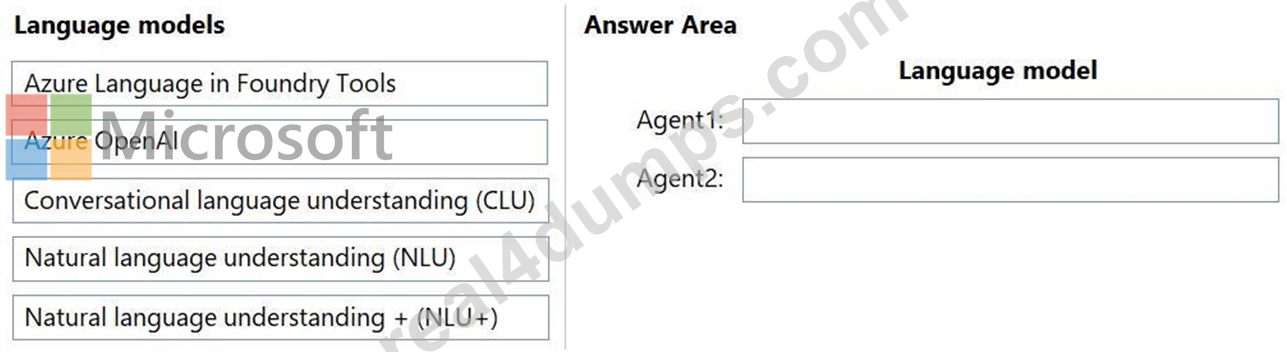
Answer:
Explanation: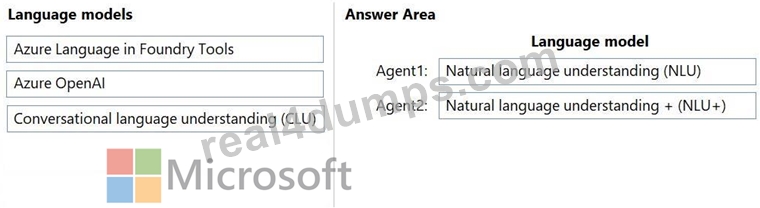
Explanation:
Box 1: Natural Language Understanding (NLU)
Agent1 must support simple and short phrases for a given topic.
For a Microsoft Copilot Studio agent that must not use generative orchestration and requires support for simple, short trigger phrases, the best choice is the Classic NLU (Natural Language Understanding) model.
When you disable generative orchestration (also known as "Generative mode" or "Generative AI" orchestration), the agent reverts to Classic orchestration. In this mode, the agent relies on predefined trigger phrases to map user input directly to specific topics.
Box 2: Natural Language Understanding + (NLU +)
Agent2 must integrate with Microsoft Dynamics 365 Contact Center voice channel.
For a Microsoft Copilot Studio agent using classic orchestration (no generative orchestration) and integrating with the Dynamics 365 Contact Center voice channel, the best language model is NLU+.
Why NLU+ is the Best Choice
While standard agents offer three "classic" Natural Language Understanding (NLU) options, NLU+ is specifically designed for high-performance, enterprise-grade scenarios like voice channels.
Note:
Comparison of Classic Models
Reference:
https://learn.microsoft.com/en-us/microsoft-copilot-studio/nlu-overview
NEW QUESTION # 56
......
Reliable Microsoft Certified AB-100 Dumps PDF Mar 28, 2026 Recently Updated Questions: https://prep4sure.real4dumps.com/AB-100-prep4sure-exam.html
