

Latest Apr-2026 InsuranceSuite-Developer Dumps PDF And Certification Training
Check your preparation for Guidewire InsuranceSuite-Developer On-Demand Exam
NEW QUESTION # 38
An insurer specializing in high-risk policies requires a new Account to provide at least three references. A Reference entity is created. What is the best practice for adding and displaying References on the Contact Summary page in TrainingApp?
- A. Create a Reference detail view with fields for three References and add it to the Contact Summary page
- B. Create a Contacts pop up and add a button that opens it to the Contact Summary page
- C. Create an input set that displays References and add it to the Contact Summary page
- D. Create a Reference list view and add it to the Contact Summary page
Answer: D
Explanation:
In Guidewire PCF (Page Configuration Framework) development, the selection of the correct widget is driven by the underlying data relationship. In this scenario, a "Reference" is a separate entity, and an Account (or Contact) is likely to have multiple instances of these references (a one-to-many relationship). According to Guidewire best practices, when you need to display a collection of objects-especially when that collection can vary in size or requires the user to see multiple entries at once-theList View (LV)is the standard and most efficient UI component.
AList Viewprovides a tabular format that allows users to view, sort, and sometimes edit multiple records simultaneously. By creating a ReferenceLV.pcf and embedding it into the ContactSummary.pcf (typically via a PanelRef), the developer provides a clean, scalable interface. This approach is superior to aDetail View (DV)because a DV is designed for a single record's specific fields; attempting to hard-code "three references" into a DV (Option A) is fragile and non-scalable if the business requirement later changes to four or five references.
Furthermore, embedding the List View directly on the Summary page ensures that the information is immediately visible to the user ("at a glance"), which aligns with the purpose of a "Summary" page. Using a Popup(Option B) adds unnecessary clicks to the user workflow, and anInput Set(Option D) is generally intended for grouping related input fields within a Detail View rather than managing a collection of entity instances. By utilizing the List View, the developer follows the architectural pattern of "Master-Detail" or
"List-Detail" commonly found throughout the InsuranceSuite applications, ensuring the UI remains consistent with the rest of the Guidewire platform.
NEW QUESTION # 39
An insurer ran the DBCC checks against a copy of their production database and found three errors with high counts in the categoryData update and reconciliation. What are two best practices for resolving the errors?
(Select two)
- A. Promote the code to production and run the DBCCs again
- B. Wait to see if error counts increase; if they increase by more than 10%, fix the errors
- C. Analyze the errors to determine the root cause and correct the code responsible for the errors
- D. Identify any bad data and write a SQL script to correct the data; run the script immediately
- E. Search the Knowledge Base on the Guidewire Community for solutions to the problems found
Answer: C,E
Explanation:
Database Consistency Checks (DBCCs) are the "canary in the coal mine" for data integrity. When high error counts appear in theData update and reconciliationcategory, it usually implies that recent configuration changes (Gosu rules, enhancements, or batch processes) are generating data that violates the underlying metadata constraints.
The first best practice isRoot Cause Analysis(Option A). Simply fixing the data in the database is a "band- aid" solution; if the underlying Gosu code that created the bad data is not fixed, the errors will immediately return. Developers must trace the lifecycle of the affected entities to find where the logic is failing.
The second best practice is to leverage theGuidewire Community Knowledge Base(Option E). Many DBCC errors, especially those following a version upgrade or a major configuration change, have been encountered by other insurers. The Knowledge Base often provides specific SQL patterns or Gosu fixes tailored to known platform behaviors.
Why other options are incorrect:
* Option Bis dangerous; never promote code known to cause database inconsistencies to a production environment.
* Option Cis irresponsible; data corruption should be addressed as soon as it is detected.
* Option Dis a partial fix, but "running the script immediately" without a code fix or support review (as discussed in Question 61) is high-risk and violates Cloud Assurance standards.
NEW QUESTION # 40
What is a benefit of archiving?
- A. Reorganizes and compresses the contents of the database to conserve space
- B. Reduces database size by permanently removing data marked for purge
- C. Improves application performance by reducing the size of the database
- D. Reindexes the contents of the database to increase data retrieval speed
Answer: C
Explanation:
Archiving is a vital data management strategy within the Guidewire InsuranceSuite, particularly for long- running production environments where the volume of historical data can grow exponentially. The primary objective of archiving is to move "closed" or "inactive" business objects-such as claims that have been settled for several years or expired policies-out of the active, operational database and into a separate, secondary storage area.
According to the Guidewire documentation, the most significant benefit of this process is theimprovement of application performance(Option B). As the operational database grows, the time required for the database engine to perform index scans, joins, and general queries increases. By periodically moving inactive data to the archive, the size of the "live" database tables remains manageable. This leads to faster search results, quicker page load times, and more efficient database maintenance tasks like backups and consistency checks.
It is important to distinguish archiving from other database operations.Purging(Option D) involves the permanent deletion of data, whereas archiving preserves the data for future retrieval or regulatory compliance.
Reindexing(Option C) andcompression(Option A) are physical database maintenance tasks that optimize how data is stored on disk but do not address the fundamental issue of data volume in the same way that moving entire business graphs to an archive does. Archiving ensures that the core application remains lean and responsive for day-to-day transactions while still fulfilling the legal and business requirements for data retention.
NEW QUESTION # 41
The Panel Ref in the screenshot below displays a List View with a toolbar. Add and Remove buttons have been added to the toolbar, but they appear in red, indicating an error. The Row Iterator has toAdd and toRemove buttons correctly defined.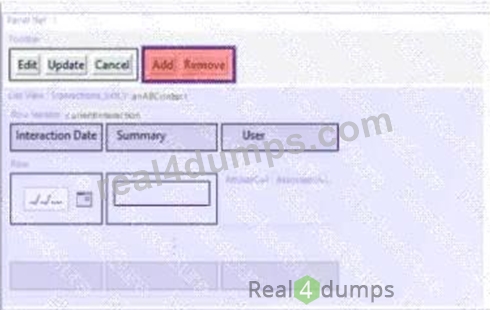
What needs to be configured to fix the error?
- A. Set the iterator property of the Add and Remove buttons
- B. Sel the addVisible and removeVisible properties of the Add and Remove buttons
- C. Set the Visible property of the row iterator
- D. Set the toCrealeAndAdd property of the row iterator
Answer: A
Explanation:
In the GuidewirePage Configuration Framework (PCF), there is a strict functional relationship between toolbar buttons and the data they manipulate. When dealing withList Views (LVs), the "Add" and "Remove" buttons are specialized widgets known asIterator Buttons.
According to theInsuranceSuite Developer Fundamentalscurriculum, placing an Iterator Button in a toolbar is only the first step. For the button to be valid, it must be linked to a specificRow Iteratorlocated within the List View. This is accomplished by setting theiteratorproperty on the Add or Remove button to theIDof the target Row Iterator.
The red error in Guidewire Studio signifies a metadata validation failure. Even if the Row Iterator has the correct toAdd and toRemove logic defined (the "how" of the operation), the buttons themselves do not yet know "where" that logic resides. By setting the iterator property, you create a direct reference that tells the button which array of objects it is responsible for managing.
Why other options are incorrect:
* Option A:toCreateAndAdd is an optional property of the Row Iterator used for overriding the default object creation logic; it does not resolve the connection error between the button and the iterator.
* Option B:addVisible and removeVisible are boolean expressions used to hide buttons based on user permissions or object state; they do not fix structural metadata errors.
* Option D:The Visible property on an iterator affects whether the list is rendered, not whether the toolbar buttons are correctly linked.
Linking the button to the iterator ID is a fundamental best practice that ensures the UI remains synchronized with the underlying data bundle.
NEW QUESTION # 42
When viewing application logs in Datadog for troubleshooting, which methods can be used to find specific information within the logs, according to the training? Select Two
- A. By querying the Lifecycle Manager API.
- B. Using the Monitors section to set up alerts.
- C. Using the search bar for full-text searches.
- D. Using the sidebar facets to filter results
- E. Creating custom dashboards with relevant widgets.
- F. By examining the build history in TeamCity.
Answer: C,D
Explanation:
In the Guidewire Cloud Platform (GWCP) ecosystem,Observabilityis primarily handled through the integration withDatadog. Developers use Datadog to monitor the health of their "Planets" and to perform deep-dive troubleshooting of application logs. Navigating through millions of log lines requires efficient filtering and searching techniques.
The two primary methods taught in the "Developing with Guidewire Cloud" course for finding specific log entries aresidebar facetsand thesearch bar.Sidebar facets(Option D) are structured filters based on log metadata. In a Guidewire context, these facets allow a developer to quickly narrow down logs by specific criteria such as the "Planet" (Dev, Pre-prod), the specific "Service" (ClaimCenter, BillingCenter), the "Log Level" (Error, Warn), or even a specific "Trace ID." This structured approach is essential for isolating errors to a specific environment or time window.
Complementing this is thesearch bar for full-text searches(Option F). This allows developers to search for specific strings within the log message itself-such as a specific Claim Number, a unique Exception class name, or a custom log prefix defined in Gosu code. By combining full-text search with facet filtering, developers can rapidly pinpoint the exact root cause of a production or development issue.
Other options are related to the cloud ecosystem but do not serve the specific purpose offinding information within logs. TeamCity (Option C) is for builds, not log analysis; and while Monitors (Option B) and Dashboards (Option E) provide higher-level views or alerts, they are not the primary tools for searching through the raw log data during an active troubleshooting session.
NEW QUESTION # 43
Which scenarios should database consistency checks be run in? (Select two)
- A. A customer created their own SQL script to populate empty columns in their production database.
- B. A customer created a new typelist and added several new typecodes to an existing typelist.
- C. A customer created a subtype of an entity that has a required column and imported data through the user interface.
- D. A customer extended an entity with a column that is not required and imported data for the column through the user interface.
- E. A customer created a new LocationRef, a folder that contains a new PCF file, Detail View, and List View.
Answer: A,C
Explanation:
Database Consistency Checks (DCCs) are designed to verify that the data in the physical database tables aligns perfectly with the metadata definitions in the Guidewire application.
The first critical scenario is whenexternal SQL scriptsare used (Option A). Guidewire's application layer usually handles all data validation and referential integrity. When a developer or DBA runs a SQL script directly against the database, they bypass these application-level checks. Running DCCs after such an operation is mandatory to ensure that the script didn't accidentally introduce null values into non-nullable columns or break foreign key constraints.
The second scenario involvesdata imports and subtype creation(Option B). When a new subtype is created with a "required" column, and data is imported-even through the UI or staging tables-there is a risk that existing records or improperly mapped import files might result in missing data for that required field. DCCs will identify these "logical" inconsistencies where the database contains a null value for a field that the application metadata now defines as mandatory.
Options C and D involve metadata changes (UI and Typelists) that do not typically risk corrupting existing table data in a way that DCCs are designed to catch. Option E is less critical because the column is "not required," so a null value is considered consistent with the data model.
NEW QUESTION # 44
Which GUnit base class is used for tests that involve Gosu queries in PolicyCenter?
- A. GUnitTestClassBase
- B. PCUnitTestClassBase
- C. SuiteDBTestClassBase
- D. PCServerTestClassBase
Answer: D
Explanation:
In theGuidewire System Health & Qualitytraining, understanding the hierarchy of GUnit base classes is essential for writing effective automated tests.
While GUnitTestClassBase (Option A) provides basic testing functionality, it does not necessarily initialize the full application server environment or the database connection required for complex operations. For tests that require thefull Guidewire stack-including the ability to executeGosu queriesagainst the database or interact with the bundle-developers must usePCServerTestClassBase(Option D) in PolicyCenter (or CCServerTestClassBase in ClaimCenter).
This base class ensures that:
* The Guidewire Application Server environment is "mocked" or started.
* The current user session is authenticated.
* The database transaction manager (Bundles) is available for queries and commits.
Using a lower-level base class for a query-based test would result in a NullPointerException or a NoSessionException because the Query API requires an active server context to translate Gosu into SQL.
NEW QUESTION # 45
A business analyst provided a requirement to create a list of Payment Types accepted by vendors. The list will include the values Cash, Credit Card, Debit Card, Check, and EFT. It will be linked to Company Vendors.
Following best practices for creating a new typelist, how can this requirement be configured in the data model?
- A. PaymentType_Ext.tti in the Extensions -> Typelist folder and add typecodes for the five payment types to the typelist
- B. PaymentType_Ext.ttx in the Extensions -> Typelist folder and add typecodes with the _Ext suffix to the typelist for the five payment types
- C. PaymentType.tix in the Metadata -> Typelist folder and add typecodes with the _Ext suffix to the typelist for the five payment types
- D. PaymentType.tti in the Metadata -> Typelist folder and add typecodes to the typelist for the five payment types
Answer: A
Explanation:
When a developer needs to introduce an entirely new set of values that does not exist in the base InsuranceSuite product, they must create anew Typelist. According to the Guidewire Data Model architecture, the proper way to define a new, customer-specific typelist is by creating a.tti (Typelist Interface) file within theExtensionsfolder of the configuration.
Following the naming conventions established for Guidewire Cloud and InsuranceSuite extensions, any new metadata object created by a customer should include the_Extsuffix. Therefore, the typelist should be named PaymentType_Ext.tti (Option C). This suffix clearly distinguishes the insurer's custom metadata from any current or future "Out of the Box" (OOTB) typelists provided by Guidewire. By placing it in the Extensions -
> Typelist folder, the developer ensures that the new list is recognized by the metadata compiler and correctly integrated into the application.
It is important to understand why the other options are incorrect:
* Option A:Uses a .ttx file. .ttx files are used only toextend existingbase typelists (adding new codes to a list Guidewire already provides). They cannot be used to define a brand-new list.
* Option B:Uses a .tix extension, which is not a valid Guidewire metadata extension, and places it in the Metadata folder, which is reserved for base product files.
* Option D:Places a .tti in the Metadata folder without the required _Ext suffix, which violates the upgrade-safety principle and risks a name collision with future base product updates.
NEW QUESTION # 46
According to the training, which application in Guidewire Home is used to configure custom quality gates for pre-merge or pre-promotion stages within the GWCP pipeline? (Select Two)
- A. Automated Builds
- B. CI/CD Manager
- C. Repository Settings
- D. Quality Gates
- E. Build Promotion
- F. Storage Access
Answer: B,D
Explanation:
In theGuidewire Cloud Platform (GWCP), the management of the delivery pipeline is handled through Guidewire Home. To ensure that only code meeting the insurer's standards reaches higher environments, developers use two specific integrated applications.
TheCI/CD Manager(Option C) is the primary hub for managing the automation pipelines. It allows developers to define the flow of code from the repository to various environments (Dev, QA, UAT). Within this application, you configure the "stages" of the build.
To enforce specific standards at these stages, theQuality Gatesapplication (Option D) is used. Quality gates act as "toll booths" in the pipeline. They can be configured to check for specific criteria, such as a minimum percentage of GUnit test coverage, a lack of critical static analysis violations, or successful execution of performance smoke tests. If a build fails to meet the threshold set in the Quality Gates configuration, the CI
/CD Manager will automatically halt the promotion, preventing "bad code" from merging into the integration branch or moving to production.
NEW QUESTION # 47
An insurance carrier plans to launch a new product for various types of Recreational Vehicles (RVs)-such as motorhomes, boats, motorcycles, and jet skis. When collecting information to quote a policy, all RVs share some common details (like purchase date, price, year, make, and model), but each type also has its own unique properties. According to best practices, what should be done to configure the User Interface so that only the relevant RV details are shown when creating a policy quote? Select Two
- A. Create separate inline Input Sets for each RV type and set the visibility on each Input Set
- B. Create a separate page for each type of RV.
- C. Create a Modal Input Set for each RV type.
- D. Create a Detail View that includes the properties that are common to all of the RV types.
- E. Define a Location Group to allow the user to choose the page for each RV type.
- F. Place an Input Set Ref on the Detail View and configure the RV type as the Mode.
Answer: D,F
Explanation:
In the Guidewire Page Configuration Framework (PCF), the primary goal for handling polymorphic data- such as a base Recreational Vehicle entity with various subtypes-is to maximize code reuse while providing a dynamic user experience. According to theInsuranceSuite Developer Fundamentalscourse, the best practice for this scenario involves a "Master-Detail" design pattern utilizingModal PCFs.
The first step (Option D) is to create a primaryDetail View (DV). This DV acts as the foundation for the UI and contains all the fields that are shared across all RV types, such as PurchaseDate, Price, and Model. By centralizing these common fields, the developer ensures that any global changes to RV data (like adding a
"Condition" field) only need to be made in one place, rather than across multiple fragmented pages.
The second step (Option E) addresses the unique properties of each RV type. Rather than cluttering the main DV with every possible field and using complex "visible" expressions (which is what Option C suggests and is discouraged due to performance and maintenance overhead), developers should use anInput Set Refwith theModeproperty set. Each specific RV type (e.g., Boat, Motorcycle) has its own separate Input Set. At runtime, the Guidewire application looks at the RV type of the current object and automatically renders the corresponding Input Set. This "Modal" approach is the standard architectural way to handle subtypes in PolicyCenter and ClaimCenter. Options A, B, and F are incorrect because they either introduce unnecessary navigation complexity or fail to leverage the built-in dynamic rendering capabilities of the PCF framework.
NEW QUESTION # 48
Which of the following represents logging best practices? Select Two
- A. Mask personally identifiable information (PII) before including it in a log message.
- B. Set the logging level to "info" in the production environment.
- C. Log all information that is necessary to diagnose the transaction.
- D. Set the logging level to "debug" in the production environment when diagnosing a production issue.
- E. Log every transaction to ensure a complete audit trail.
Answer: A,C
Explanation:
Effective logging in Guidewire InsuranceSuite is a balance between providing enough information for troubleshooting and maintaining system security and performance. Two of the most critical best practices involveData PrivacyandDiagnostic Context.
First,Masking PII(Option A) is a non-negotiable requirement for modern insurance applications, especially those running on the Guidewire Cloud Platform. Personally Identifiable Information, such as social security numbers, credit card details, or even specific personal names and addresses, must never appear as clear text in the application logs. Logs are often aggregated into secondary systems (like Datadog or CloudWatch) and viewed by a wide range of support personnel. If PII is not masked or removed before logging, the company risks failing compliance audits (GDPR, HIPAA, etc.) and exposing sensitive data.
Second, developers should strive tolog all information necessary to diagnose the transaction(Option D).
This means providing context, such as a PublicID, a specific TransactionID, or the state of an object at the time of an error. Without this context, log entries like "Error processing claim" are useless for troubleshooting. The goal is to provide enough detail so that a developer can understand the failure path without needing to step through the code in a debugger.
Other options are incorrect because they represent poor operational or performance choices. Setting the level to "debug" in production (Option C) can lead to severe performance degradation due to high I/O. While "info" (Option B) is a common default, it is not a "best practice" in the same functional sense as security and diagnosis. Finally, "logging every transaction" (Option E) is not the purpose of application logs; audit trails should be handled via the system's built-inHistoryorEvent Messagingtables, not the text-based log files, to avoid overwhelming the storage and performance of the application.
NEW QUESTION # 49
Given the image: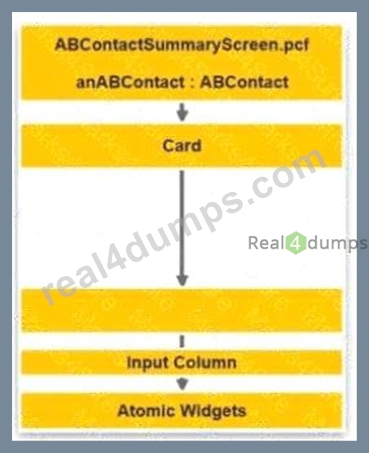
Which container type must be added between Card and Input Column?
- A. List View
- B. Detail View
- C. Input Set
- D. Detail View PCF File
Answer: B
Explanation:
TheGuidewire Page Configuration Framework (PCF)follows a strict nesting hierarchy to ensure that the layout engine can correctly render widgets on the screen. According to theInsuranceSuite Developer Fundamentalscurriculum, specifically the lesson on "Container Widget Usage," developers must understand the parent-child relationships required for different layout styles.
ACardwidget is a component of aCardViewPanel, used to create tabbed interfaces within a page. However, a Card itself cannot directly host anInput Column. Instead, a Card serves as a container for other panels. To display data fields in the standard column-based layout favored by InsuranceSuite, aDetailViewPanel (commonly referred to simply as aDetail Viewin the Studio palette) must be placed inside the Card.
TheDetail Viewacts as the intermediate container that establishes the data context (the row or entity being edited) and provides the grid system necessary for theInput Column. The Input Column, in turn, allows developers to align fields vertically. Without the Detail View container, the PCF would be syntactically invalid because the layout engine requires the Detail View to manage the labels and input alignment for any child columns.
Option A is incorrect because a "PCF File" is the entire document, not a widget added to a tree. Option C (List View) is used for tabular data, not column-based input layouts. Option D (Input Set) is a grouping mechanism that sitsinsideoralongsidean Input Column but cannot serve as the parent to one. Therefore, adding aDetail View(B) is the correct and necessary step to bridge the hierarchy between the Card and its Input Columns.
NEW QUESTION # 50
The company has requested to group 3 new Pages, within Claim Details, in the left navigation. Which configuration best practice should be used to implement this requirement?
- A. Define the Page links in a reusable InputSet file to group the new pages.
- B. Configure the new Page navigations within the TabBar definition.
- C. Configure a new LocationGroup to group the new pages.
- D. Implement each new Page as a LocationRef with its own Hyperlink widget.
- E. Use a MenuItemIterator widget to create the heading and organize the Page links.
Answer: C
Explanation:
The Guidewire UI is organized into a hierarchy ofLocations, and the primary mechanism for grouping related pages in the side navigation (the "sidebar" or "west panel") is theLocationGroup. When a business requirement calls for grouping multiple pages under a single heading-such as adding three specialized inquiry pages within the "Claim Details" area-a LocationGroup is the standard architectural choice.
A LocationGroup acts as a container for multiple LocationRef elements (which point to specific Pages, Worksheets, or other Groups). By defining a new LocationGroup (Option E), the developer can create a nested navigation structure. This results in a cleaner UI where a single parent entry in the sidebar can be expanded to reveal the three sub-pages. This follows the design pattern used throughout InsuranceSuite (for example, the "Financials" or "Parties Involved" sections in ClaimCenter).
Options A, B, and C are incorrect because they use the wrong widgets or locations for side-navigation logic.
TabBar (Option B) is for top-level application switching (like moving between Claim, Policy, and Desktop), not for internal page grouping. InputSet (Option C) is for grouping fields within a page, not for managing navigation locations. MenuItemIterator (Option D) is generally used for dynamic menu generation (like a list of recent claims) rather than static structural navigation. Using a LocationGroup ensures that the navigation remains declarative and consistent with the platform's breadcrumb and security permission logic.
NEW QUESTION # 51
What are two types of Guidewire Profiler? (Select two)
- A. Exit-point
- B. Database Performance
- C. Entry-point
- D. Worksheet
Answer: C,D
Explanation:
TheGuidewire Profileris a powerful diagnostic tool used to analyze the performance of Gosu code, database queries, and rule execution within the application. It helps developers identify bottlenecks by providing a detailed breakdown of where time is being spent during a specific operation.
According to the "System Health & Quality" training, the Profiler is categorized based on how the profiling data is captured and viewed. The two primary types areEntry-pointandWorksheet.
* Entry-point Profiler (Option B):This is used to profile a specific "entry point" into the application, such as a Web Service call, a Batch Process, or a specific PCF Page load. When a developer enables an entry-point profiler, the system records every operation (Gosu execution, SQL query, etc.) that occurs from the moment the entry point is triggered until it completes. This is essential for diagnosing high- latency API calls or slow-running background tasks.
* Worksheet Profiler (Option D):This type is accessible directly within the application UI via the
"Worksheet" (the slide-up panel at the bottom). It allows a developer or tester to profile their own current session. By clicking "Enable Profiler" in the worksheet, the developer can perform a specific action (like clicking a button or saving a claim) and immediately view the performance trace once the action finishes.
Options A (Exit-point) and C (Database Performance) are not standard names for the Profiler types in Guidewire. While the Profilermeasuresdatabase performance, it is not a "type" of Profiler itself.
Understanding the difference between these types allows developers to choose the right diagnostic tool depending on whether they are troubleshooting a user-interface issue (Worksheet) or a systemic back-end performance problem (Entry-point).
NEW QUESTION # 52
This sample code uses array expansion with dot notation and has performance issues: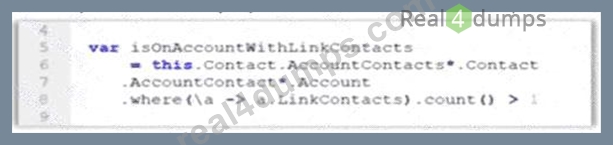
What best practice is recommended to resolve the performance issues?
- A. Replace the dot notation syntax with ArrayLoader syntax
- B. Rewrite the code to use a nested for loop
- C. Replace the .where clause with a .compare function
- D. Break the code into multiple queries to process each array
Answer: B
Explanation:
In the Guidewire InsuranceSuite Developer training, specifically within theAdvanced Gosumodules, the
"Array Expansion Operator" (*.) is identified as a double-edged sword. While it provides a clean, declarative syntax for gathering properties from an array of objects into a new collection, it is a common source of performance degradation in complex configurations.
The technical reason for this performance hit is that every time the expansion operator is invoked, Gosu must create anintermediate, temporary collectionin memory to hold the projected values. If you are expanding multiple levels (e.g., Claim.Exposures*.Contacts*.Address), the system is essentially building multiple
"throwaway" lists in the application server's heap. For large datasets, this leads to high memory overhead and triggers frequent garbage collection cycles, which slows down the entire application.
Guidewire's official recommendation is torewrite the code using a nested for loop(Option A). By using explicit procedural iteration, the developer eliminates the need for these hidden intermediate collections. A nested loop allows for "streaming" the data-processing each item as it is reached rather than collecting everything into a list first. This is significantly more memory-efficient. Additionally, nested loops allow developers to integrate "early exit" logic or filters that can prevent the system from even attempting to load certain records from the database, further optimizing the transaction. Following this best practice ensures that the code is not only easier to debug using the Guidewire Profiler but also scales predictably as the insurer's data volume grows.
NEW QUESTION # 53
......
Valid InsuranceSuite-Developer Dumps for Helping Passing Guidewire Exam: https://prep4sure.real4dumps.com/InsuranceSuite-Developer-prep4sure-exam.html
