

[Dec-2025] CrowdStrike CCFR-201 Dumps - Secret To Pass in First Attempt
CrowdStrike CCFR-201 Exam Dumps [2025] Practice Valid Exam Dumps Question
CrowdStrike CCFR-201 Exam Syllabus Topics:
| Topic | Details |
|---|---|
| Topic 1 |
|
| Topic 2 |
|
| Topic 3 |
|
| Topic 4 |
|
NEW QUESTION # 13
You are notified by a third-party that a program may have redirected traffic to a malicious domain. Which Falcon page will assist you in searching for any domain request information related to this notice?
- A. Falcon X
- B. Discover
- C. Spotlight
- D. Investigate
Answer: D
Explanation:
Explanation
According to the [CrowdStrike website], the Investigate page is where you can search for and analyze various types of data collected by the Falcon platform, such as events, hosts, processes, hashes, domains, IPs, etc1. You can use various tools, such as Event Search, Host Search, Process Timeline, Hash Search, Bulk Domain Search, etc., to perform different types of searches and view the results in different ways1. If you want to search for any domain request information related to a notice from a third-party, you can use the Investigate page to do so1. For example, you can use the Bulk Domain Search tool to search for the malicious domain and see which hosts and processes communicated with it1. You can also use the Event Search tool to search for DNSRequest events that contain the malicious domain and see more details about the query and response1.
NEW QUESTION # 14
How long are quarantined files stored on the host?
- A. 45 Days
- B. 90 Days
- C. Quarantined files are never deleted from the host
- D. 30 Days
Answer: C
Explanation:
Explanation
According to the CrowdStrike Falcon Data Replicator (FDR) Add-on for Splunk Guide, quarantined files are never deleted from the host unless you manually delete them or release them from quarantine2. When you release a file from quarantine, you are restoring it to its original location and allowing it to execute on any host in your organization2. This action also removes the file from the quarantine list and deletes it from the CrowdStrike Cloud2.
NEW QUESTION # 15
From the Detections page, how can you view 'in-progress' detections assigned to Falcon Analyst Alex?
- A. Alex does not have the correct role permissions as a Falcon Analyst to be assigned detections
- B. Filter on 'Status: In-Progress' and 'Assigned-to: Alex*
- C. Filter on 'Hostname: Alex' and 'Status: In-Progress'
- D. Filter on'Analyst: Alex'
Answer: B
Explanation:
Explanation
According to the CrowdStrike Falcon Data Replicator (FDR) Add-on for Splunk Guide, the Detections page allows you to view and manage detections generated by the CrowdStrike Falcon platform2. You can use various filters to narrow down the detections based on criteria such asstatus, severity, tactic, technique, etc2. To view 'in-progress' detections assigned to Falcon Analyst Alex, you can filter on 'Status: In-Progress' and 'Assigned-to: Alex*'2. The asterisk (*) is a wildcard that matches any characters after Alex2.
NEW QUESTION # 16
What happens when a quarantined file is released?
- A. It is allowed to execute on the host
- B. It is moved into theC:\CrowdStrike\Quarantine\Releasedfolder on the host
- C. It is deleted
- D. It is allowed to execute on all hosts
Answer: D
Explanation:
Explanation
According to the CrowdStrike Falcon Data Replicator (FDR) Add-on for Splunk Guide, when you release a file from quarantine, you are restoring it to its original location and allowing it to execute on any host in your organization1. This action also removes the file from the quarantine list and deletes it from the CrowdStrike Cloud1.
NEW QUESTION # 17
What does pivoting to an Event Search from a detection do?
- A. It takes you to the raw Insight event data and provides you with a number of Event Actions
- B. It gives you the ability to search for similar events on other endpoints quickly
- C. It takes you to a Process Timeline for that detection so you can see all related events
- D. It allows you to input an event type, such as DNS Request or ASEP write, and search for those events within the detection
Answer: A
Explanation:
Explanation
According to the CrowdStrike Falcon Devices Add-on for Splunk Installation and Configuration Guide v3.1.5+, pivoting to an Event Search from a detection takes you to the raw Insight event data and provides you with a number of Event Actions1. Insight events are low-level events that are generated by the sensor for various activities, such as process executions, file writes, registry modifications, network connections, etc1. You can view these events in a table format and use various filters and fields to narrow down the results1. You can also select one or more events and perform various actions, such as show a process timeline, show a host timeline, show associated event data, show a +/- 10-minute window of events, etc1. These actions can help you investigate and analyze events more efficiently and effectively1.
NEW QUESTION # 18
How long does detection data remain in the CrowdStrike Cloud before purging begins?
- A. 45 Days
- B. 90 Days
- C. 30 Days
- D. 14 Days
Answer: B
Explanation:
Explanation
According to the CrowdStrike Falcon Data Replicator (FDR) Add-on for Splunk Guide, detection data is stored in the CrowdStrike Cloud for 90 days before purging begins2. This means that you can access and view detections from the past 90 days using the Falcon platform or API2. If you want to retain detection data for longer than 90 days, you can use FDR to replicate it to your own storage system2.
NEW QUESTION # 19
Which of the following is NOT a filter available on the Detections page?
- A. Severity
- B. Triggering File
- C. CrowdScore
- D. Time
Answer: B
Explanation:
Explanation
According to the CrowdStrike Falcon Data Replicator (FDR) Add-on for Splunk Guide, the Detections page allows you to view and manage detections generated by the CrowdStrike Falcon platform2. You can use various filters to narrow down the detections based on criteria such as severity, CrowdScore, time, tactic, technique, etc2. However, there is no filter for triggering file, which is the file that caused the detection2.
NEW QUESTION # 20
From a detection, what is the fastest way to see children and sibling process information?
- A. Right-click the process and select "Follow Process Chain"
- B. Select the Process Timeline feature, enter the AID. Target Process ID, and Parent Process ID
- C. Select the Event Search option. Then from the Event Actions, select Show Associated Event Data (From TargetProcessld_decimal)
- D. Select Full Detection Details from the detection
Answer: D
Explanation:
Explanation
According to the CrowdStrike Falcon Data Replicator (FDR) Add-on for Splunk Guide, the Full Detection Details tool allows you to view detailed information about a detection, such as detection ID, severity, tactic, technique, description, etc1. You can also view the events generated by the processes involved in the detection in different ways, such as process tree, process timeline, or process activity1. The process tree view provides a graphical representation of the process hierarchy and activity1. You can see children and sibling processes information by expanding or collapsing nodes in the tree1.
NEW QUESTION # 21
How long are quarantined files stored in the CrowdStrike Cloud?
- A. 45 Days
- B. 90 Days
- C. Quarantined files are not deleted
- D. Days
Answer: B
Explanation:
Explanation
According to the [CrowdStrike Falcon Data Replicator (FDR) Add-on for Splunk Guide], when you quarantine a file from a host using IOC Management or Real Time Response (RTR), you are moving it from its original location to a secure location on the host where it cannot be executed. The file is also encrypted and renamed with a random string of characters. A copy of the file is also uploaded to the CrowdStrike Cloud for further analysis. Quarantined files are stored in the CrowdStrike Cloud for 90 days before they are deleted.
NEW QUESTION # 22
The function of Machine Learning Exclusions is to___________.
- A. Stop all Machine Learning Preventions but a detection will still be generated and files will still be uploaded to the CrowdStrike Cloud
- B. stop all detections for a specific pattern ID
- C. stop all ML-based detections and preventions for the matching path(s) and/or stop files from being uploaded to the CrowdStrike Cloud
- D. stop all sensor data collection for the matching path(s)
Answer: C
Explanation:
Explanation
According to the CrowdStrike Falcon Data Replicator (FDR) Add-on for Splunk Guide, Machine Learning Exclusions allow you to exclude files or directories from being scanned by CrowdStrike's machine learning engine, which can reduce false positives and improveperformance2. You can also choose whether to upload the excluded files to the CrowdStrike Cloud or not2.
NEW QUESTION # 23
What is an advantage of using the IP Search tool?
- A. IP searches provide manufacture and timezone data that can not be accessed anywhere else
- B. IP searches provide host, process, and organizational unit data without the need to write a query
- C. IP searches allow for multiple comma separated IPv6 addresses as input
- D. IP searches offer shortcuts to launch response actions and network containment on target hosts
Answer: B
Explanation:
Explanation
According to the CrowdStrike Falcon Devices Add-on for Splunk Installation and Configuration Guide v3.1.5+, the IP Search tool allows you to search for an IP address and view a summary of information from Falcon events that contain that IP address1. The summary includes the hostname, sensor ID, OS, country, city, ISP, ASN, geolocation, process name, command line, and organizational unit of the host that communicated with that IP address1. This is an advantage of using the IP Search tool because it provides host, process, and organizational unit data without the need to write a query1.
NEW QUESTION # 24
Which of the following is returned from the IP Search tool?
- A. IP Summary information from Falcon events containing the given IP
- B. Unmanaged host data from system ARP tables for the given IPD.IP Detection Summary information for detection events containing the given IP
- C. Threat Graph Data for the given IP from Falcon sensors
Answer: A
Explanation:
Explanation
According to the CrowdStrike Falcon Devices Add-on for Splunk Installation and Configuration Guide v3.1.5+, the IP Search tool allows you to search for an IP address and view a summary of information from Falcon events that contain that IP address1. The summary includes the hostname, sensor ID, OS, country, city, ISP, ASN, and geolocation of the host that communicated with that IP address1.
NEW QUESTION # 25
When examining a raw DNS request event, you see a field called ContextProcessld_decimal. What is the purpose of that field?
- A. It contains the ContextProcessld_decimal value for the parent process that made the DNS request
- B. It contains the TargetProcessld_decimal value for other related events
- C. It contains the TargetProcessld_decimal value for the process that made the DNS request
- D. It contains an internal value not useful for an investigation
Answer: C
Explanation:
Explanation
According to the CrowdStrike Falcon Devices Add-on for Splunk Installation and Configuration Guide v3.1.5+, the ContextProcessld_decimal field contains the decimal value of the process ID of the process that generated the event1. This field can be used to trace the process lineage and identify malicious or suspicious activities1. For a DNS request event, this field indicates which process made the DNS request1.
NEW QUESTION # 26
Which Executive Summary dashboard item indicates sensors running with unsupported versions?
- A. Inactive Sensors
- B. Active Sensors
- C. Sensors in RFM
- D. Detections by Severity
Answer: C
Explanation:
Explanation
According to the CrowdStrike Falcon Devices Add-on for Splunk Installation and Configuration Guide v3.1.5+, the Executive Summary dashboard provides an overview of your sensor health and activity1. It includes various items, such as Active Sensors, Inactive Sensors, Detections by Severity, etc1. The item that indicates sensors running with unsupported versions is Sensors in RFM (Reduced Functionality Mode)1. RFM is a state where a sensor has limited functionality due to various reasons, such as license expiration, network issues, tampering attempts, or unsupported versions1. You can see the number and percentage of sensors in RFM and the reasons why they are in RFM1.
NEW QUESTION # 27
What happens when you open the full detection details?
- A. The process explorer opens and you're able to view the processes and process relationships
- B. The process explorer opens and the detection copies to the clipboard
- C. Theprocess explorer opens and the detection is removed from the console
- D. The process explorer opens and the Event Search query is run for the detection
Answer: A
Explanation:
Explanation
According to the [CrowdStrike Falcon Data Replicator (FDR) Add-on for Splunk Guide], when you open the full detection details from a detection alert or dashboard item, you are taken to a page where you can view detailed information about the detection, such as detection ID, severity, tactic, technique, description, etc. You can also view the events generated by the processes involved in the detection in different ways, such as process tree, process timeline, or process activity. The process tree view is also known as the process explorer, which provides a graphical representation of the process hierarchy and activity. You can view the processes and process relationships by expanding or collapsing nodes in the tree. You can also see the event types and timestamps for each process.
NEW QUESTION # 28
When examining raw event data, what is the purpose of the field called ParentProcessld_decimal?
- A. It contains the TargetProcessld_decimal value of the child process
- B. It contains the Sensorld_decimal value for related events
- C. It contains the TargetProcessld_decimal of the parent process
- D. It contains an internal value not useful for an investigation
Answer: C
Explanation:
Explanation
According to the CrowdStrike Falcon Devices Add-on for Splunk Installation and Configuration Guide v3.1.5+, the ParentProcessld_decimal field contains the decimal value of the process ID of the parent process that spawned or injected into the target process1. This field can be used to trace the process lineage and identify malicious or suspicious activities1.
NEW QUESTION # 29
After running an Event Search, you can select many Event Actions depending on your results. Which of the following is NOT an option for any Event Action?
- A. Show a +/- 10-minute window of events
- B. Show Associated Event Data (from TargetProcessld_decimal or ContextProcessld_decimal)
- C. Draw Process Explorer
- D. Show a Process Timeline for the responsible process
Answer: C
Explanation:
Explanation
According to the CrowdStrike Falcon Devices Add-on for Splunk Installation and Configuration Guide v3.1.5+, the Event Search tool allows you to search for events based on various criteria, such as event type, timestamp, hostname, IP address, etc1. You can also select one or more events and perform various actions, such as show a process timeline, show a host timeline, show associated event data, show a +/- 10-minute window of events, etc1. However, there is no option to draw a process explorer, which is a graphical representation of the process hierarchy and activity1.
NEW QUESTION # 30
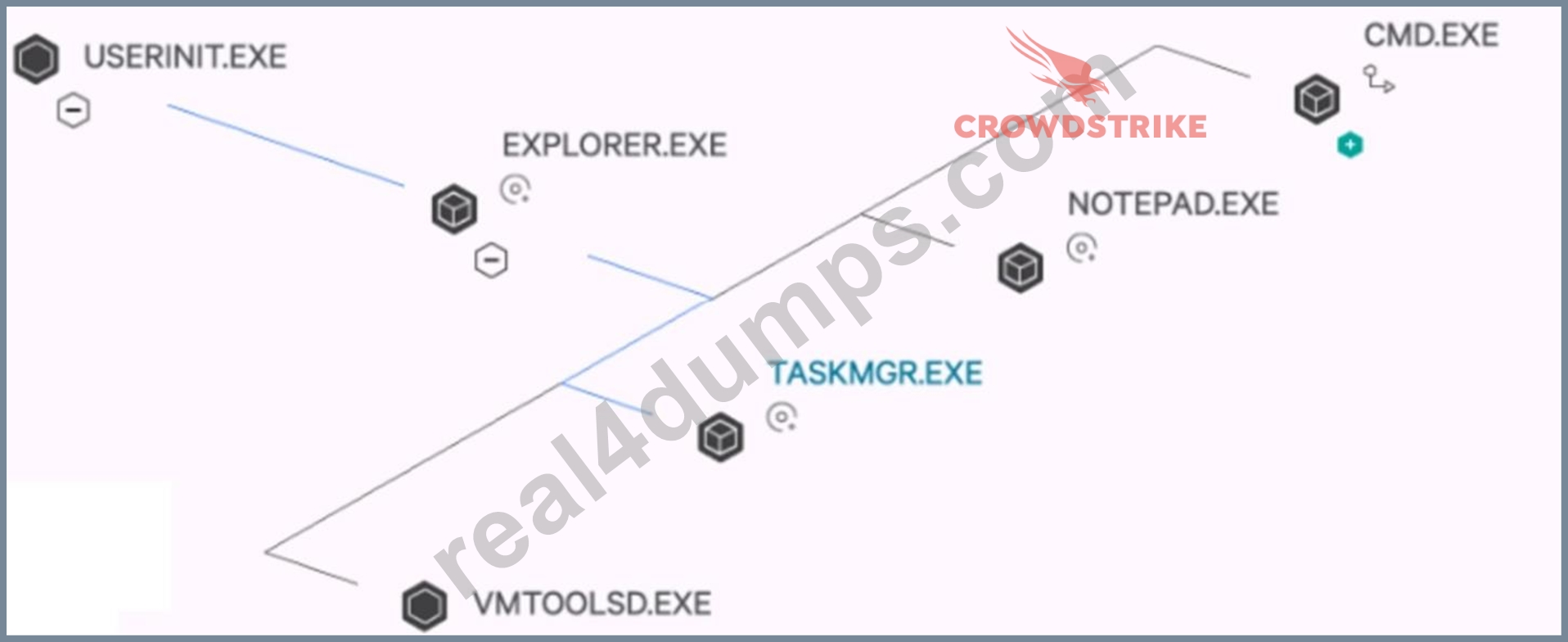
How are processes on the same plane ordered (bottom 'VMTOOLSD.EXE' to top CMD.EXE')?
- A. Process ID (Descending, highest on bottom)
- B. Time started (Ascending, most recent on top)
- C. Process ID (Ascending, highest on top)
- D. Time started (Descending, most recent on bottom)
Answer: D
Explanation:
Explanation
According to the CrowdStrike Falcon Devices Add-on for Splunk Installation and Configuration Guide v3.1.5+, the process tree view provides a visualization of program ancestry, which shows the parent-child and sibling relationships among the processes1. You can also see the event types and timestamps for each process1. The processes on the same plane are ordered by time started in descending order, meaning that the most recent process is at the bottom and the oldest process is at the top1. For example, in the image you sent me, CMD.EXE is the oldest process and VMTOOLSD.EXE is the most recent process on that plane1.
NEW QUESTION # 31
What is the difference between Managed and Unmanaged Neighbors in the Falcon console?
- A. A managed sensor has an active prevention policy
- B. A managed neighbor is currently network contained and an unmanaged neighbor is uncontained
- C. An unmanaged neighbor is in a segmented area of the network
- D. A managed neighbor has an installed and provisioned sensor
Answer: D
Explanation:
Explanation
According to the CrowdStrike Falcon Data Replicator (FDR) Add-on for Splunk Guide, you can use the Hosts page in the Investigate tool to view information about your endpoints, such as hostname, IP address, OS, sensor version, etc2. You can also see a list of managed and unmanaged neighbors for each endpoint, which are other devices that have communicated with that endpoint over the network2. A managed neighbor is a device that has an installed and provisioned sensor that reports to the CrowdStrike Cloud2. An unmanaged neighbor is a device that does not have an installed or provisioned sensor2.
NEW QUESTION # 32
When you configure and apply an IOA exclusion, what impact does it have on the host and what you see in the console?
- A. The associated detection will be suppressed and the associated process would have been allowed to run
- B. The process specified is not sent to the Falcon Sandbox for analysis
- C. The sensor will stop sending events from the process specified in the regex pattern
- D. The associated IOA will still generate a detection but the associated process would have been allowed to run
Answer: A
Explanation:
Explanation
According to the CrowdStrike Falcon Data Replicator (FDR) Add-on for Splunk Guide, IOA exclusions allow you to exclude files or directories from being detected or blocked by CrowdStrike's indicators of attack (IOAs), which are behavioral rules that identify malicious activities1. This can reduce false positives and improve performance1. When you configure and apply an IOA exclusion, the impact is that the associated detection will be suppressed and theassociated process would have been allowed to run1. This means that you will not see any alerts or events related to that IOA in the console1.
NEW QUESTION # 33
What action is used when you want to save a prevention hash for later use?
- A. No Action
- B. Always Block
- C. Always Allow
- D. Never Block
Answer: B
Explanation:
Explanation
According to the CrowdStrike Falcon Data Replicator (FDR) Add-on for Splunk Guide, the Always Block action allows you to block a file from executing on any host in your organization based on its hash value2. This action can be used to prevent known malicious files from running on your endpoints2.
NEW QUESTION # 34
Which statement is TRUE regarding the "Bulk Domains" search?
- A. The "Bulk Domains" search will allow you to blocklist your queried domains
- B. It will show a list of computers and process that performed a lookup of any of the domains in your search
- C. The "Bulk Domains" search will show IP address and port information for any associated connectionsD.You should only pivot to the "Bulk Domains" search tool after completing an investigation
Answer: B
Explanation:
Explanation
According to the CrowdStrike Falcon Devices Add-on for Splunk Installation and Configuration Guide v3.1.5+, the Bulk Domain Search tool allows you to search for one or more domains and view a summary of information from Falcon events that contain those domains2. The summary includes the hostname, sensor ID, OS, country, city, ISP, ASN, geolocation, process name, command line, and organizational unit of the host that performed a lookup of any of the domains in your search2. This can help you identify potential threats or vulnerabilities in your network2.
NEW QUESTION # 35
What action is used when you want to save a prevention hash for later use?
- A. No Action
- B. Always Block
- C. Always Allow
- D. Never Block
Answer: B
Explanation:
Explanation
According to the CrowdStrike Falcon Data Replicator (FDR) Add-on for Splunk Guide, the Always Block action allows you to block a file from executing on any host in your organization based on its hash value2. This action can be used to prevent known malicious files from running on your endpoints2.
NEW QUESTION # 36
......
CCFR-201 Exam Dumps PDF Guaranteed Success with Accurate & Updated Questions: https://prep4sure.real4dumps.com/CCFR-201-prep4sure-exam.html
